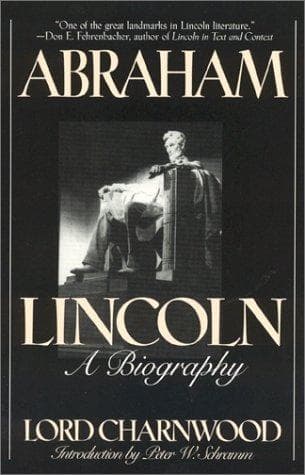
Abraham LincolnCharnwood, Godfrey Rathbone Benson, Baron
History
Abraham Lincoln
Charnwood, Godfrey Rathbone Benson, Baron
Lincoln, Abraham, 1809-1865; Presidents -- United States -- Biography
Controversy over this tariff raged for fully four years, and had a
memorable issue. In the course of 1830 the doctrine of "nullification"
and "secession" was discussed in the Senate, and the view of Calhoun was
expounded by one Senator Hayne. Webster answered him in a speech which
he meant should become a popular classic, and which did become so. He
set forth his own doctrine of the Union and appealed to national against
State loyalty in the most influential oration that was perhaps ever made.
"His utterance," writes President Wilson, "sent a thrill through all the
East and North which was unmistakably a thrill of triumph. Men were glad
because of what he had said. He had touched the national
self-consciousness, awakened it, and pleased it with a morning vision of
its great tasks and certain destiny." Later there came in the President,
the redoubtable Andrew Jackson, the most memorable President between
Jefferson and Lincoln. He said very little--only, on Jefferson's
birthday he gave the toast, "Our Federal Union; it must be preserved."
But when in 1832, in spite of concessions by Congress, a Convention was
summoned in South Carolina to "nullify" the tariff, he issued the
appropriate orders to the United States Army, in case such action was
carried out, and it is understood that he sent Calhoun private word that
he would be the first man to be hanged for treason. Nullification
quietly collapsed. The North was thrilled still more than by Webster's
oratory, and as not a single other State showed signs of backing South
Carolina, it became thenceforth the fixed belief of the North that the
Union was recognised as in law indissoluble, as Webster contended it was.
None the less the idea of secession had been planted, and planted in a
fertile soil.
General Andrew Jackson, whose other great achievements must now be told,
was not an intellectual person, but his ferocious and, in the literal
sense, shocking character is refreshing to the student of this period.
He had been in his day the typical product of the West--a far wilder West
than that from which Lincoln later came. Originally a lawyer, he had won
martial fame in fights with Indians and in the celebrated victory over
the British forces at New Orleans. He was a sincere Puritan; and he had
a courtly dignity of manner; but he was of arbitrary and passionate
temper, and he was a sanguinary duellist. His most savage duels, it
should be added, concerned the honour of a lady whom he married
chivalrously, and loved devotedly to the end. The case that can be made
for his many arbitrary acts shows them in some instances to have been
justifiable, and shows him in general to have been honest.
Public-domain text, read in full here on John Shaqi.
Reviews
Reviews
No reviews yet
Be the first to share your thoughts on this work.
Join the Discussion
Join the discussion
Sign in to leave a comment or review.
Sign InorCreate an account