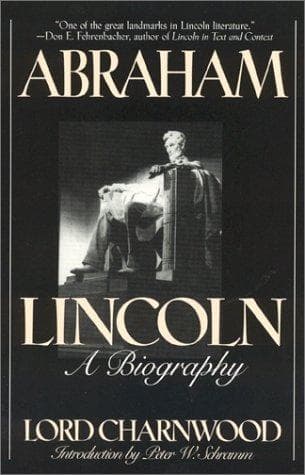
Abraham LincolnCharnwood, Godfrey Rathbone Benson, Baron
History
Abraham Lincoln
Charnwood, Godfrey Rathbone Benson, Baron
Lincoln, Abraham, 1809-1865; Presidents -- United States -- Biography
When in 1824 Jackson had expected to become President, and, owing to
proceedings which do not now matter, John Quincy Adams, son of a former
President, and himself a remarkable man, was made President instead of
him, Jackson resolved to overthrow the ruling class of Virginian country
gentlemen and Boston city magnates which seemed to him to control
Government, and to call into life a real democracy. To this end he
created a new party, against which of course an opposition party arose.
Neither of the new parties was in any sense either aristocratic or
democratic. "The Democracy," or Democratic party, has continued in
existence ever since, and through most of Lincoln's life ruled America.
In trying to fix the character of a party in a foreign country we cannot
hope to be exact in our portraiture. At the first start, however, this
party was engaged in combating certain tendencies to Government
interference in business. It was more especially hostile to a National
Bank, which Jackson himself regarded as a most dangerous form of alliance
between the administration and the richest class. Of the growth of what
may be called the money power in American politics he had an intense,
indeed prophetic, dread. Martin Van Buren, his friend and successor,
whatever else he may have been, was a sound economist of what is now
called the old school, and on a financial issue he did what few men in
his office have done, he deliberately sacrificed his popularity to his
principles. Beyond this the party was and has continued prone, in a
manner which we had better not too clearly define, to insist upon the
restrictions of the Constitution, whether in the interest of individual
liberty or of State rights. This tendency was disguised at the first by
the arbitrary action of Jackson's own proceedings, for Jackson alone
among Presidents displayed the sentiments of what may be called a popular
despot. Its insistence upon State rights, aided perhaps by its dislike
of Protection, attracted to it the leading politicians of the South, who
in the main dominated its counsels, though later on they liked to do it
through Northern instruments. But it must not in the least be imagined
that either party was Northern or Southern; for there were many Whigs in
the South, and very many Democrats in the North. Moreover, it should be
clearly grasped, though it is hard, that among Northern Democrats
insistence on State rights did not involve the faintest leaning towards
the doctrine of secession; on the contrary a typical Democrat would
believe that these limitations to the power of the Union were the very
things that gave it endurance and strength. Slavery, moreover, had
friends and foes in both parties. If we boldly attempted to define the
prevailing tone of the Democrats we might say that, while they and their
opponents expressed loyalty to the Union and the Constitution, the
Democrats would be prone to lay the emphasis upon the Constitution.
Public-domain text, read in full here on John Shaqi.
Reviews
Reviews
No reviews yet
Be the first to share your thoughts on this work.
Join the Discussion
Join the discussion
Sign in to leave a comment or review.
Sign InorCreate an account