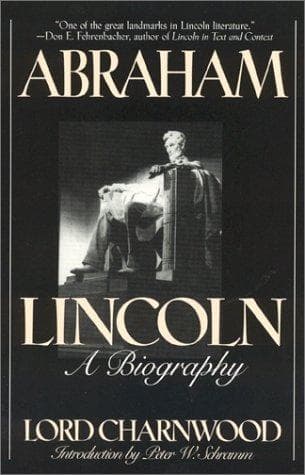
Abraham LincolnCharnwood, Godfrey Rathbone Benson, Baron
History
Abraham Lincoln
Charnwood, Godfrey Rathbone Benson, Baron
Lincoln, Abraham, 1809-1865; Presidents -- United States -- Biography
So much for the great world of politics in those days. But in or about
1830 a Quaker named Lundy had, as Quakers used to say, "a concern" to
walk 125 miles through the snow of a New England winter and speak his
mind to William Lloyd Garrison. Garrison was a poor man who, like
Franklin, had raised himself as a working printer, and was now occupied
in philanthropy. Stirred up by Lundy, he succeeded after many painful
experiences, in gaol and among mobs, in publishing in Boston on January
1, 1831, the first number of the Liberator. In it he said: "I shall
strenuously contend for the immediate enfranchisement of our slave
population. I will be as hard as truth and as uncompromising as justice.
I will not equivocate; I will not excuse; I will not retreat a single
inch; and I will be heard." This was the beginning of the new
Abolitionist movement. The Abolitionists, in the main, were
impracticable people; Garrison in the end proved otherwise. Under the
existing Constitution, they had nothing to propose but that the free
States should withdraw from "their covenant with death and agreement with
hell"--in other words, from the Union,--whereby they would not have
liberated one slave. They included possibly too many of that sort who
would seek salvation by repenting of other men's sins. But even these
did not indulge this propensity at their ease, for by this time the
politicians, the polite world, the mass of the people, the churches (even
in Boston), not merely avoided the dangerous topic; they angrily
proscribed it. The Abolitionists took their lives in their hands, and
sometimes lost them. Only two men of standing helped them: Channing, the
great preacher, who sacrificed thereby a fashionable congregation; and
Adams, the sour, upright, able ex-President, the only ex-President who
ever made for himself an after-career in Congress. In 1852 a still more
potent ally came to their help, a poor lady, Mrs. Beecher Stowe, who in
that year published "Uncle Tom's Cabin," often said to have influenced
opinion more than any other book of modern times. Broadly speaking, they
accomplished two things. If they did not gain love in quarters where
they might have looked for it, they gained the very valuable hatred of
their enemies; for they goaded Southern politicians to fury and madness,
of which the first symptom was their effort to suppress Abolitionist
petitions to Congress. But above all they educated in their labour of
thirty years a school of opinion, not entirely in agreement with them but
ready one day to revolt with decision from continued complicity in wrong.
6. _Slavery and Southern Society_.
In the midst of this growing America, a portion, by no means sharply
marked off, and accustomed to the end to think itself intensely American,
was distinguished by a peculiar institution. What was the character of
that institution as it presented itself in 1830 and onwards?
Public-domain text, read in full here on John Shaqi.
Reviews
Reviews
No reviews yet
Be the first to share your thoughts on this work.
Join the Discussion
Join the discussion
Sign in to leave a comment or review.
Sign InorCreate an account