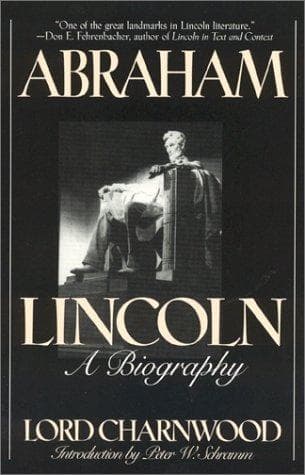
Abraham LincolnCharnwood, Godfrey Rathbone Benson, Baron
History
Abraham Lincoln
Charnwood, Godfrey Rathbone Benson, Baron
Lincoln, Abraham, 1809-1865; Presidents -- United States -- Biography
The days of really great moneyed interests and of corruption of the
gravest sort were as yet far distant, but one demoralising influence was
imposed upon the new party system by its author at its birth. Jackson,
in his perpetual fury, believed that office holders under the more or
less imaginary ruling clique that had held sway were a corrupt gang, and
he began to turn them out. He was encouraged to extend to the whole
country a system which had prevailed in New York and with which Van Buren
was too familiar. "To the victors belong the spoils," exclaimed a
certain respectable Mr. Marcy. A wholesale dismissal of office holders
large and small, and replacement of them by sound Democrats, soon took
place. Once started, the "spoils system" could hardly be stopped.
Thenceforward there was a standing danger that the party machine would be
in the hands of a crew of jobbers and dingy hunters after petty offices.
England, of course, has had and now has practices theoretically as
indefensible, but none possessing any such sinister importance. It is
hard, therefore, for us to conceive how little of really vicious intent
was necessary to set this disastrous influence going. There was no
trained Civil Service with its unpartisan traditions. In the case of
offices corresponding to those of our permanent heads of departments it
seemed reasonable that the official should, like his chief the Minister
concerned, be a person in harmony with the President. As to the smaller
offices--the thousands of village postmasterships and so forth--one man
was likely to do the work as well as another; the dispossessed official
could, in the then condition of the country, easily find another equally
lucrative employment; "turn and turn about" seemed to be the rule of fair
play.
There were now few genuine issues in politics. Compromise on vital
questions was understood to be the highest statesmanship. The
Constitution itself, with its curious system of checks and balances,
rendered it difficult to bring anything to pass. Added to this was a
party system with obvious natural weaknesses, infected from the first
with a dangerous malady. The political life, which lay on the surface of
the national life of America, thus began to assume an air of futility,
and, it must be added, of squalor. Only, Englishmen, recollecting the
feebleness and corruption which marked their aristocratic government
through a great part of the eighteenth century, must not enlarge their
phylacteries at the expense of American democracy. And it is yet more
important to remember that the fittest machinery for popular government,
the machinery through which the real judgment of the people will prevail,
can only by degrees and after many failures be devised. Popular
government was then young, and it is young still.
Public-domain text, read in full here on John Shaqi.
Reviews
Reviews
No reviews yet
Be the first to share your thoughts on this work.
Join the Discussion
Join the discussion
Sign in to leave a comment or review.
Sign InorCreate an account