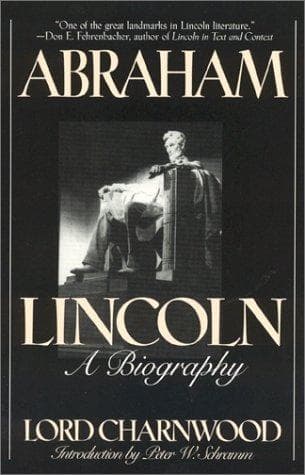
Abraham LincolnCharnwood, Godfrey Rathbone Benson, Baron
History
Abraham Lincoln
Charnwood, Godfrey Rathbone Benson, Baron
Lincoln, Abraham, 1809-1865; Presidents -- United States -- Biography
The connection between slavery and politics was this; as population
slowly grew in the South, and as the land in the older States became to
some extent exhausted, the desire for fresh territory in which
cultivation by slaves could flourish became stronger and stronger. This
was the reason for which the South became increasingly aware of a
sectional interest in politics. In all other respects the community of
public interests, of business dealings, and of general intercourse was as
great between North and South as between East and West. It is certain
that throughout the South, with the doubtful exception of South Carolina,
political instinct and patriotic pride would have made the idea of
separation intolerable upon any ground except that of slavery. In regard
to this matter of dispute a peculiar phenomenon is to be observed. The
quarrel grew not out of any steady opposition between North and South,
but out of the habitual domination of the country by the South and the
long-continued submission of the North to that domination.
For the North had its full share of blame for the long course of
proceedings which prepared the coming tragedy, and the most impassioned
writers on the side of the Union during the Civil War have put that blame
highest. The South became arrogant and wrong-headed, and no defence is
possible for the chief acts of Southern policy which will be recorded
later; but the North was abject. To its own best sons it seemed to have
lost both its conscience and its manhood, and to be stifled in the coils
of its own miserable political apparatus. Certainly the prevailing
attitude of the Northern to the Southern politicians was that of
truckling. And Southerners who went to Washington had a further reason
for acquiring a fatal sense of superiority to the North. The tradition
of popular government which maintained itself in the South caused men who
were respected, in private life, and were up to a point capable leaders,
who were, in short, representative, to be sent to Congress and to be kept
there. The childish perversion of popular government which took hold of
the newer and more unsettled population in the North led them to send to
Congress an ever-changing succession of unmeritable and sometimes shady
people. The eventual stirring of the mind of the North which so closely
concerns this biography was a thing hard to bring about, and to the South
it brought a great shock of surprise.
7. _Intellectual Development_.
Public-domain text, read in full here on John Shaqi.
Reviews
Reviews
No reviews yet
Be the first to share your thoughts on this work.
Join the Discussion
Join the discussion
Sign in to leave a comment or review.
Sign InorCreate an account