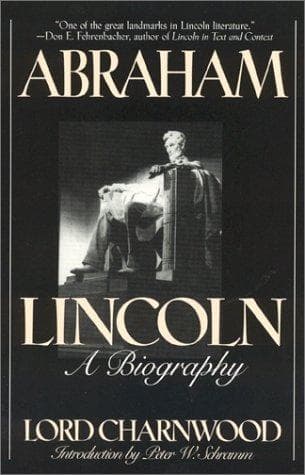
Abraham LincolnCharnwood, Godfrey Rathbone Benson, Baron
History
Abraham Lincoln
Charnwood, Godfrey Rathbone Benson, Baron
Lincoln, Abraham, 1809-1865; Presidents -- United States -- Biography
No survey of the political movements of this period should conclude
without directing attention to something more important, which cannot be
examined here. In the years from 1830 till some time after the death of
Lincoln, America made those contributions to the literature of our common
language which, though neither her first nor her last, seemed likely to
be most permanently valued. The learning and literature of America at
that time centred round Boston and Harvard University in the adjacent
city of Cambridge, and no invidious comparison is intended or will be
felt if they, with their poets and historians and men of letters at that
time, with their peculiar atmosphere, instinct then and now with a life
athletic, learned, business-like and religious, are taken to show the
dawning capacities of the new nation. No places in the United States
exhibit more visibly the kinship of America with England, yet in none
certainly can a stranger see more readily that America is independent of
the Old World in something more than politics. Many of their streets and
buildings would in England seem redolent of the past, yet no cities of
the Eastern States played so large a part in the development, material
and mental, of the raw and vigorous West. The limitations of their
greatest writers are in a manner the sign of their achievement. It would
have been contrary to all human analogy if a country, in such an early
stage of creation out of such a chaos, had put forth books marked
strongly as its own and yet as the products of a mature national mind.
It would also have been surprising if since the Civil War the rush of
still more appalling and more complex practical problems had not
obstructed for a while the flow of imaginative or scientific production.
But the growth of those relatively early years was great. Boston had
been the home of a loveless Christianity; its insurrection in the War of
Independence had been soiled by shifty dealing and mere acidity; but
Boston from the days of Emerson to those of Phillips Brooks radiated a
temper and a mental force that was manly, tender, and clean. The man
among these writers about whose exact rank, neither low nor very high
among poets, there can be least dispute was Longfellow. He might seem
from his favourite subjects to be hardly American; it was his
deliberately chosen task to bring to the new country some savour of
things gentle and mellow caught from the literature of Europe. But, in
the first place, no writer could in the detail of his work have been more
racy of that New England countryside which lay round his home; and, in
the second place, no writer could have spoken more unerringly to the ear
of the whole wide America of which his home was a little part. It seems
strange to couple the name of this mild and scholarly man with the
thought of that crude Western world to which we must in a moment pass.
But the connection is real and vital. It is well shown in the
Public-domain text, read in full here on John Shaqi.
Reviews
Reviews
No reviews yet
Be the first to share your thoughts on this work.
Join the Discussion
Join the discussion
Sign in to leave a comment or review.
Sign InorCreate an account