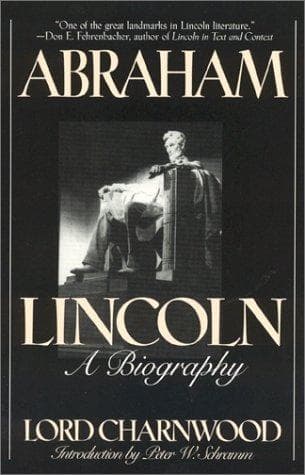
Abraham LincolnCharnwood, Godfrey Rathbone Benson, Baron
History
Abraham Lincoln
Charnwood, Godfrey Rathbone Benson, Baron
Lincoln, Abraham, 1809-1865; Presidents -- United States -- Biography
To this succinct declaration of policy may be added from his earlier
letter that he advocated a law against usury, and laws for the
improvement of education. The principles of the speech are those which
the new Whig party was upholding against the Democrats under Jackson
(the President) and Van Buren. Lincoln's neighbours, like the people
of Illinois generally, were almost entirely on the side of the
Democrats. It is interesting that however he came by his views, they
were early and permanently fixed on the side then unpopular in
Illinois; and it is interesting that though, naturally, not elected, he
secured very nearly the whole of the votes of his immediate
neighbourhood.
The penniless Lincoln was now hankering to become a lawyer, though with
some thoughts of the more practicable career of a blacksmith.
Unexpectedly, however, he was tempted into his one venture, singularly
unsuccessful, in business. Two gentlemen named Herndon, cousins of a
biographer of Lincoln's, started a store in New Salem and got tired of
it. One sold his share to a Mr. Berry, the other sold his to Lincoln.
The latter sale was entirely on credit--no money passed at the time,
because there was no money. The vendor explained afterwards that he
relied solely on Lincoln's honesty. He had to wait a long while for
full payment, but what is known of storekeeping in New Salem shows that
he did very well for himself in getting out of his venture as he did.
Messrs. Berry and Lincoln next acquired, likewise for credit, the stock
and goodwill of two other storekeepers, one of them the victim of a
raid from Clary's Grove. The senior partner then applied himself
diligently to personal consumption of the firm's liquid goods; the
junior member of the firm was devoted in part to intellectual and
humorous converse with the male customers, but a fatal shyness
prevented him from talking to the ladles. For the rest, he walked long
distances to borrow books, got through Gibbon and through Rollin's
"History of the World," began his study of Blackstone, and acquired a
settled habit of reading novels. So business languished. Early in
1833 Berry and Lincoln sold out to another adventurer. This also was a
credit transaction. The purchaser without avoidable delay failed and
disappeared. Berry then died of drink, leaving to Lincoln the sole
responsibility for the debts of the partnership. Lincoln could with no
difficulty and not much reproach have freed himself by bankruptcy. As
a matter of fact, he ultimately paid everything, but it took him about
fifteen years of striving and pinching himself.
Public-domain text, read in full here on John Shaqi.
Reviews
Reviews
No reviews yet
Be the first to share your thoughts on this work.
Join the Discussion
Join the discussion
Sign in to leave a comment or review.
Sign InorCreate an account