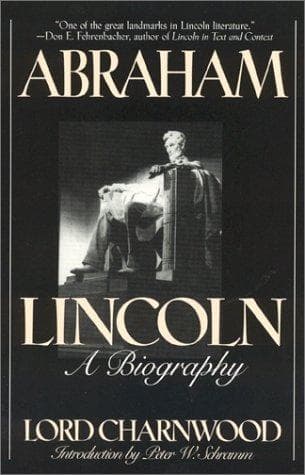
Abraham LincolnCharnwood, Godfrey Rathbone Benson, Baron
History
Abraham Lincoln
Charnwood, Godfrey Rathbone Benson, Baron
Lincoln, Abraham, 1809-1865; Presidents -- United States -- Biography
Lincoln is one of the many public characters to whom the standing
epithet "honest" became attached; in his case the claim to this rested
originally on the only conclusive authority, that of his creditors.
But there is equally good authority, that of his biographer, William
Herndon, for many years his partner as a lawyer, that "he had no money
sense." This must be understood with the large qualification that he
meant to pay his way and, unlike the great statesmen of the eighteenth
century in England, did pay it. But, though with much experience of
poverty in his early career, he never developed even a reasonable
desire to be rich. Wealth remained in his view "a superfluity of the
things one does not want." He was always interested in mathematics,
but mainly as a discipline in thinking, and partly, perhaps, in
association with mechanical problems of which he was fond enough to
have once in his life patented an invention. The interest never led
him to take to accounts or to long-sighted financial provisions. In
later days, when he received a payment for his fees, his partner's
share would be paid then and there; and perhaps the rent would be paid,
and the balance would be spent at once in groceries and other goods
likely to be soon wanted, including at long intervals, when the need
was very urgent, a new hat.
These are amiable personal traits, but they mark the limitations of his
capacity as a statesman. The chief questions which agitated the
Illinois Legislature were economic, and so at first were the issues
between Whigs and Democrats in Federal policy. Lincoln, though he
threw himself into these affairs with youthful fervour, would appear
never to have had much grasp of such matters. "In this respect alone,"
writes an admirer, "I have always considered Mr. Lincoln a weak man."
It is only when (rarely, at first) constitutional or moral issues
emerge that his politics become interesting. We can guess the causes
which attached him to the Whigs. As the party out of power, and in
Illinois quite out of favour, they had doubtless some advantage in
character. As we have seen, the greatest minds among American
statesmen of that day, Webster and Clay, were Whigs. Lincoln's simple
and quite reasonable, if inconclusive, argument for Protection, can be
found among his speeches of some years later. And schemes of internal
development certainly fired his imagination.
Public-domain text, read in full here on John Shaqi.
Reviews
Reviews
No reviews yet
Be the first to share your thoughts on this work.
Join the Discussion
Join the discussion
Sign in to leave a comment or review.
Sign InorCreate an account