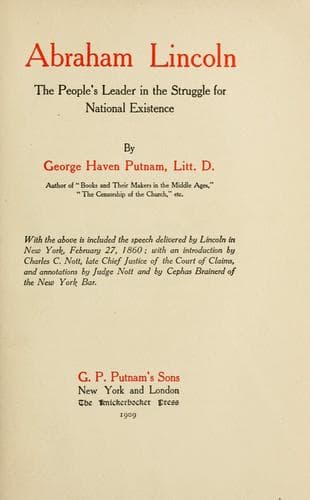
Abraham Lincoln: The People's Leader in the Struggle for National ExistencePutnam, George Haven
History
Abraham Lincoln: The People's Leader in the Struggle for National Existence
Putnam, George Haven
Lincoln, Abraham, 1809-1865; United States -- History -- Civil War, 1861-1865
"_Art._ 6. There shall be neither slavery nor involuntary servitude in
the said Territory otherwise than in the punishment of crimes whereof
the party shall have been duly convicted; provided always that any
person escaping into the same, from whom labor or service is lawfully
claimed in any one of the original States, such fugitive may be lawfully
reclaimed, and conveyed to the person claiming his or her labor or
service."
On passing the ordinance, the ayes and nays were required by Judge
Yates, of New York, when it appeared _that his was the only vote in the
negative_.
The ordinance of April 23, 1784, was a brief outline of that of '87. It
was reported by a Committee, of which Mr. Jefferson was chairman, and
the report contained a slavery prohibition intended to take effect in
1800. This was stricken out of the report, six States voting to retain
it--three voting to strike out--one being divided (N.C.), and the others
not being represented. (The assent of nine States was necessary to
retain any provision.) And this is the vote alluded to by Mr. Lincoln.
But subsequently, March 16, 1785, a motion was made by Rufus King to
commit a proposition "that there be neither slavery nor involuntary
servitude" in any of the Territories; which was carried by the vote of
eight States, including Maryland.--_Journal Am. Congress,_ vol. 4, pp.
373, 380, 481, 752.
When, therefore, the ordinance of '87 came before Congress, on its final
passage, the subject of slavery prohibition had been "_agitated_" for
nearly three years; and the deliberate and almost unanimous vote of that
body upon that question leaves no room to doubt what the fathers
believed, and how, in that belief, they acted.]
[Footnote 11:--It singularly and fortunately happens that one of the
"thirty-nine," "while engaged on that instrument," viz., while
advocating its ratification before the Pennsylvania Convention, did
express an opinion upon this "precise question," which opinion was
_never_ disputed or doubted, in that or any other Convention, and was
accepted by the opponents of the Constitution, as an indisputable fact.
This was the celebrated James Wilson, of Pennsylvania. The opinion is as
follows:--
MONDAY, _Dec._ 3, 1787.
Public-domain text, read in full here on John Shaqi.
Reviews
Reviews
No reviews yet
Be the first to share your thoughts on this work.
Elsewhere in the archive
Join the Discussion
Join the discussion
Sign in to leave a comment or review.
Sign InorCreate an account