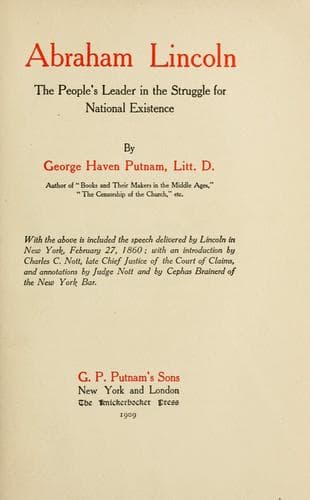
Abraham Lincoln: The People's Leader in the Struggle for National ExistencePutnam, George Haven
History
Abraham Lincoln: The People's Leader in the Struggle for National Existence
Putnam, George Haven
Lincoln, Abraham, 1809-1865; United States -- History -- Civil War, 1861-1865
"With respect to the clause restricting Congress from prohibiting the
migration or importation of such persons as any of the States now
existing shall think proper to admit, prior to the year 1808: The Hon.
gentleman says that this clause is not only dark, but intended to grant
to Congress, for that time, the power to admit the importation of
slaves. No such thing was intended; but I will tell you what was done,
and it gives me high pleasure that so much was done. Under the present
Confederation, the States may admit the importation of slaves as long as
they please; but by this article, after the year 1808, the Congress will
have power to prohibit such importation, notwithstanding the disposition
of any State to the contrary. I consider this as laying the foundation
for banishing slavery out of this country; and though the period is more
distant than I could wish, yet it will produce the same kind, gradual
change which was pursued in Pennsylvania. It is with much satisfaction
that I view this power in the general government, whereby they may lay
an interdiction on this reproachful trade. But an immediate advantage is
also obtained; for a tax or duty may be imposed on such importation, not
exceeding $10 for each person; and this, sir, operates as a partial
prohibition; it was all that could be obtained. I am sorry it was no
more; but from this I think there is reason to hope that yet a few
years, and it will be prohibited altogether. _And in the meantime, the
new States which are to be formed will be under the control of Congress
in this particular, and slaves will never be introduced amongst
them_."--2 _Elliott's Debates_, 423.
It was argued by Patrick Henry in the Convention in Virginia, as
follows:
"May not Congress enact that every black man must fight? Did we not see
a little of this in the last war? We were not so hard pushed as to make
emancipation general. But acts of Assembly passed, that every slave who
would go to the army should be free. Another thing will contribute to
bring this event about. Slavery is detested. We feel its fatal effects.
We deplore it with all the pity of humanity. Let all these
considerations press with full force on the minds of Congress. Let that
urbanity which, I trust, will distinguish America, and the necessity of
national defence--let all these things operate on their minds, they will
search that paper, and see if they have power of manumission. And have
they not, sir? Have they not power to provide for the general defence
and welfare? May they not think that these call for the abolition of
slavery? May they not pronounce all slaves free, and will they not be
warranted by that power? There is no ambiguous implication, no logical
deduction. The paper speaks to the point; they have the power in clear,
unequivocal terms, and will clearly and certainly exercise it."--3
_Elliott's Debates_, 534.
Public-domain text, read in full here on John Shaqi.
Reviews
Reviews
No reviews yet
Be the first to share your thoughts on this work.
Elsewhere in the archive
Join the Discussion
Join the discussion
Sign in to leave a comment or review.
Sign InorCreate an account