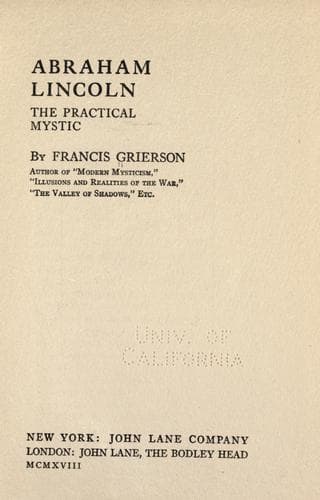
Abraham Lincoln: The Practical Mystic — John Shaqi
Abraham Lincoln: The Practical MysticGrierson, Francis
Religion
Abraham Lincoln: The Practical Mystic
Grierson, Francis
Lincoln, Abraham, 1809-1865 -- Psychology
_Lincoln's Clairvoyant Wit_
Lincoln was not deceived by an outward show of religion. A Southern
woman begged the President to have her husband released from a Northern
prison, "for," she said, "although he is a Rebel he is a very religious
man." Lincoln replied: "I am glad to hear that, because any man who
wants to disrupt this Union needs all the religion in sight to save
him."
He treated with indifference people who commandeered. A haughty woman
came to Lincoln and demanded a colonel's commission for her son. "I
demand it," she said, "not as a favour but as a right. Sir, my
grandfather fought at Lexington, my father fought at New Orleans, and my
husband was killed at Monterey."
"I guess, Madam," was Lincoln's reply, "your family has done enough for
the country. It is time to give some one else a chance."
When Hugh McCullough, Secretary of the Treasury in Lincoln's second
term, presented a delegation of New York bankers at the White House,
McCullough said: "These gentlemen of New York have come on to see the
Secretary of the Treasury about our new loan. As bankers, they are
obliged to hold our national securities. I can vouch for their
patriotism and loyalty, for, as the good Book says, 'Where the treasure
is there will the heart be also.'"
To which Lincoln replied: "There is another text, Mr. McCullough, I
remember, that might equally apply, 'Where the carcass is there will the
eagles be gathered together.'"
Lincoln condemned as tedious a certain Greek history. When a diplomat
present said: "The author of that history, Mr. President, is one of the
profoundest scholars of the age; no one has plunged more deeply into the
sacred fount of learning."
"Yes," replied Lincoln, "or come up drier."
When in Chicago in 1860, the mayor, John Wentworth, asked Lincoln why he
did not get some astute politician to _run_ him, Lincoln replied that
"events and not a man's own exertions made presidents."
To Henry C. Whitney, Lincoln remarked: "Judd and Ray and those fellows
think I don't see anything, but I see all around them. I see better what
they want to do with me than they do themselves."
They were deceived, not by Lincoln, who never cared what individuals
thought, but by Nature, which often sets a trap for people who live in a
world of their own illusions. Nature, the medium through which the
Divine mind manifests, is, so to speak, a mask through which egoists
cannot penetrate and by which the cunning are led to destruction.
Lincoln let them talk and even act, knowing that they themselves were
the tools for their own undoing. While the ward politicians and others,
who thought themselves far superior, laid their plans, schemed, and
intrigued, the man of clear vision awaited unperturbed the events which
he knew would put them all in their proper places. Little did they dream
that they were mere incidents among the million of incidents that go to
the making of one epoch-making event.
Public-domain text, read in full here on John Shaqi.
Reviews
Reviews
No reviews yet
Be the first to share your thoughts on this work.
Join the Discussion
Join the discussion
Sign in to leave a comment or review.
Sign InorCreate an account