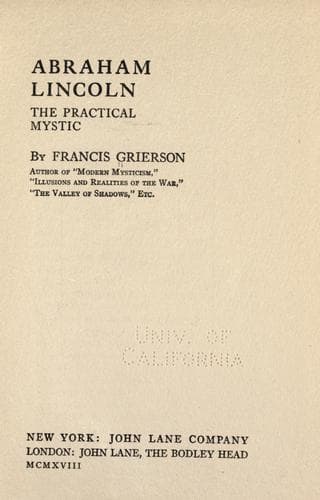
Abraham Lincoln: The Practical Mystic — John Shaqi
Abraham Lincoln: The Practical MysticGrierson, Francis
Religion
Abraham Lincoln: The Practical Mystic
Grierson, Francis
Lincoln, Abraham, 1809-1865 -- Psychology
When they returned to Springfield Lincoln remained silent for a long
time. At last one of his friends asked him what he thought of the sermon
and he replied that he "little dreamed that such power could be given to
mortal man, for those words were from beyond the speaker. Peter Akers
has convinced me that American slavery will go down with the crash of
civil war." Then he added: "Gentlemen, you may be surprised and think it
strange, but when the preacher was describing the civil war I distinctly
saw myself, as in second sight, bearing an important part in that
strife."
The next morning Mr. Lincoln came very late to his office, and Mr.
Herndon, glancing at his haggard face, exclaimed: "Why, Lincoln, what's
the matter?" Then Lincoln told him about the great sermon and said: "I
am utterly unable to shake myself free from the conviction that I shall
be involved in that terrible war."
_Illumination of the Spirit_
When Lincoln, young and unknown, visited New Orleans as a flat-boatman
and saw men and women being sold at auction in the public mart, he said
to the friend who was with him: "If ever I get a chance to hit that
thing I'll hit it hard."
Who was this young man, whose clothes were in tatters, who was without
patrons, to suggest such a thing as a chance to strike even a feeble
blow at the institution of slavery? Dr. Gregg, commenting on this
memorable incident, asks:
"Why did Lincoln utter these words? Was it an illumination of the Spirit
forecasting the Civil War? Was it a whisper by a divine messenger that
he was to be the chosen one to wipe the thing from the earth and give
deliverance to millions of his fellow men?"
Few, if any, of Lincoln's biographers have touched on his early life
with more than a superficial notion of its significance. Judge Whitney,
in spite of his great knowledge and his deep insight, divides Lincoln's
life into two parts, the first being uninspired, the second
supernaturally wonderful. The truth is that the first part of his life
contained a clear forecast of the second. Lincoln at the age of
fifty-five was the same man, unchanged, excepting by experience. Only in
fairy stories are people changed from fools into philosophers.
Public-domain text, read in full here on John Shaqi.
Reviews
Reviews
No reviews yet
Be the first to share your thoughts on this work.
Join the Discussion
Join the discussion
Sign in to leave a comment or review.
Sign InorCreate an account