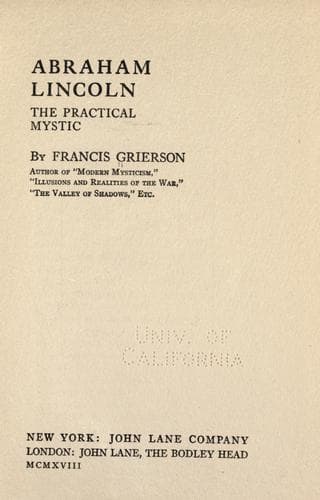
Abraham Lincoln: The Practical MysticGrierson, Francis
Religion
Abraham Lincoln: The Practical Mystic
Grierson, Francis
Lincoln, Abraham, 1809-1865 -- Psychology
Herndon was right when he said that Lincoln's features were stamped with
the seal of nature. This is the only seal that is beyond imitation. All
else can be mimicked. We have seen how ghastly one or two persons
appeared when they attempted to look like Lincoln. The imitation took on
the appearance of pale, dull putty. The notion that Lincoln's
personality could be imitated with success was quite in keeping with
that other notion that the great President was, in spite of everything,
just one of the common people. But Lincoln as he appears in popular
histories, and Lincoln as he was known to his associates and those who
came into personal contact with him, are two different persons. Perhaps
no one has summed up the matter with such concision and force as Don
Piatt, who knew him well:--
"With all his awkwardness of manner and utter disregard of social
conventionalities that seemed to invite familiarity, there was something
about Abraham Lincoln that enforced respect. No man presumed on the
apparent invitation to be other than respectful. I was told at
Springfield that this accompanied him through life. Among his rough
associates, when young, he was leader, looked up to and obeyed, because
they felt of his muscle and its readiness in use. Among his associates
at the bar it was attributed to his wit, which kept his duller
associates at a distance. But the fact was that this power came from a
sense of reserve force of intellectual ability that no one took account
of save in its results. Through one of those manifestations of nature
that produce a Shakespeare at long intervals, a giant had been born to
the poor whites of Kentucky and the sense of superiority possessed
Lincoln at all times. Seward, Chase, and Stanton, great as they were,
felt their inferiority to their master."
_Law and Authority_
We are beginning to feel the reality of that power that lies above
appearance and formula, that power manifested in Job and Isaiah, which
we accept as inspiration in religion, intuition in philosophy, and
illumination in art, producing saints in one age and mystical scientists
in another.
We float through the ether on a revolving miracle called the earth,
returning again and again to attain the same figure on the dial of time.
The things done by human automatons count for nothing in the course of
destiny.
We think we are wise when we invent a new name for an old truth; and
vanity aims to confine the infinite within the limits of a stopper
bottle or a glass showcase, or attain inspiration by means of a ouija
board.
Can any one conceive what would have happened to this country had
Lincoln made use of such a contrivance to direct the course of his
actions? This scourge of dead agnostics seems like an ironical stroke of
nature to discount their disbelief. Not only does this clumsy instrument
make wits like Mark Twain "talk like poor Pol," but it makes
philosophers reason like first-grade pupils at our common schools.
Public-domain text, read in full here on John Shaqi.
Reviews
Reviews
No reviews yet
Be the first to share your thoughts on this work.
Join the Discussion
Join the discussion
Sign in to leave a comment or review.
Sign InorCreate an account