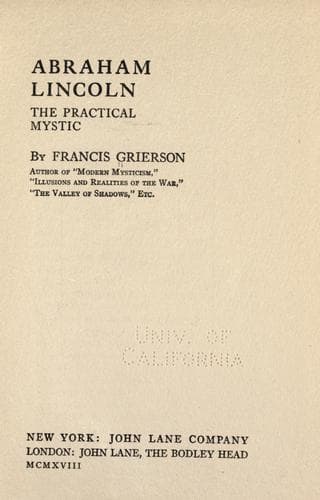
Abraham Lincoln: The Practical Mystic — John Shaqi
Abraham Lincoln: The Practical MysticGrierson, Francis
Religion
Abraham Lincoln: The Practical Mystic
Grierson, Francis
Lincoln, Abraham, 1809-1865 -- Psychology
Immortality is destined to have the last word even though it be
pronounced in the most fantastic manner.
Lincoln believed in law, order, and authority. He believed in the
mission of the churches. He was a regular worshipper in Dr. Gurley's
Presbyterian congregation at the Capital. He was a praying president,
like George Washington, and, while he was not a member of any church, he
was convinced that all the churches were necessary. He was not a
free-thinker, as that term is commonly used. Loose reasoning and vague,
uncertain doctrines he could not abide. He demanded proofs and would not
accept a man's word merely from sentimental motives. No one ever induced
him to "side-track" from the main line of argument and reason. His
attitude in the matter of inspiration and spiritual direction may be
summed up in a few words spoken at the time a delegation of Chicago
ministers came to him, urging him in God's name to free the slaves
without further delay. His reply was that when the Almighty wanted him
to free the slaves He would deal directly with Lincoln himself instead
of indirectly through Chicago.
A vacillating President would have been influenced by such a request at
such a time, but the President had faith in his own illuminations and
awaited orders from a Supreme source. Had he been influenced by advice
given by all sorts of people who called at the White House on all sorts
of missions, possessing no authority themselves, what turmoil and chaos
would have resulted to the army and the Nation!
Practical mystic that he was, he did not seek, nor wish for, advice from
people in matters which concerned his own judgment alone. It is true
that on several occasions he was approached by persons who came with
messages of various kinds assumed to be spiritual, but Lincoln received
them with a neutral politeness, sometimes mingled with a grim humour, as
when Robert Dale Owen read to him a long manuscript presumed to be
highly inspirational and illuminating, and Lincoln replied, "Well, for
those who like that sort of thing that is the thing they would like."
_Lincoln as Critic_
Nothing escaped Lincoln's powers of philosophical and metaphysical
analysis. He did not read the Bible and Shakespeare merely for pleasure,
as people read novels. He could give excellent reasons for everything he
did. Even in his most listless moods he never lost his firm grip on
affairs, both general and individual. When he read a book it was because
there was something in it which helped him to penetrate deeper into the
recesses of life and character. He would study a passage or a chapter
until he had assimilated its wisdom and its mystical import.
Public-domain text, read in full here on John Shaqi.
Reviews
Reviews
No reviews yet
Be the first to share your thoughts on this work.
Join the Discussion
Join the discussion
Sign in to leave a comment or review.
Sign InorCreate an account