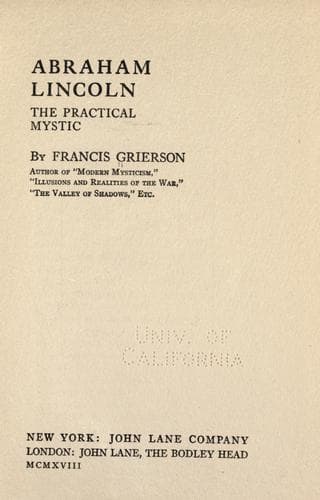
Abraham Lincoln: The Practical Mystic — John Shaqi
Abraham Lincoln: The Practical MysticGrierson, Francis
Religion
Abraham Lincoln: The Practical Mystic
Grierson, Francis
Lincoln, Abraham, 1809-1865 -- Psychology
Lincoln was passionately fond of geometry. His oratory was based on
logic, but his logic came from the mystical absolute, a geometric
science of the soul which he alone could appropriate through his
perception of fundamental principles of universal law. He could perceive
that an idea is a personal conception of a mathematical truth, as
distinguished from mere beliefs, notions, and sentiments. Others turned
politics into the art of influencing crowds through their sentimental
opinions; Lincoln engaged in trying to make them think logically. While
others gave vague reasons for their political views he gave reasons
based on law which he explained with simple force and lucid phraseology.
He never attempted to tell all he knew. The practical mystic never does.
He knew how he acquired his knowledge, but his reticence was as
pronounced as his gift of expression. It was this quality of reticence
that kept him from taking counsel from all sorts of statesmen and
explaining the inexplicable. There was not a man among them that could
have understood. In this, Lincoln was a mystic, full-fledged, initiated,
as by centuries of experience. His innate wisdom told him exactly how
much the people could understand, how much politicians could digest, and
how much statesmen could divine. Not only did he hold the allegiance of
the Whigs, but he gained the allegiance of the Abolitionists. This,
indeed, was intellect illumined.
_The Old and the New_
How old yet new are nature's moods and manifestations! How mysteriously
the souvenirs of the past are revived and quickened in new forms, faces,
and phenomena! The seasons come and go with varying moods and seem new,
but they are older than the formulas of civilisation; strangers bring
with them new influences, but we discover in them something familiar
from the vague and shadowy past. Every single thing is related to every
other thing, and illuminated minds are the periods that separate the
cycles, but not the laws, of human progress. The form is new; the
principle remains unchangeable. Solomon was unique in his glory, but
Athens had a Pericles, Rome a Cæsar, Europe a Bonaparte, and the new
world a Lincoln.
Real genius is elemental. It influences humanity as much as heat and
cold, rain and sunshine. People who offer the greatest opposition to it
are those who fall before its onward march. Indeed, it seems to be, from
all historical accounts, a sort of car of Juggernaut to those who
wilfully oppose it. And this is not surprising since it is the greatest
power of which man has any personal knowledge, supported by all the
forces of the material and the spiritual.
_Destiny versus Will_
Great men float into power on mystical waves moved by the force of
destiny. The greater the mind the greater the fixture of force behind
it.
Public-domain text, read in full here on John Shaqi.
Reviews
Reviews
No reviews yet
Be the first to share your thoughts on this work.
Join the Discussion
Join the discussion
Sign in to leave a comment or review.
Sign InorCreate an account