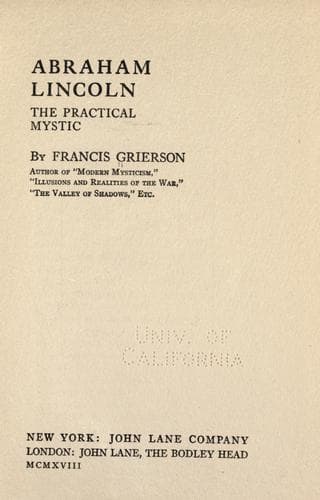
Abraham Lincoln: The Practical MysticGrierson, Francis
Religion
Abraham Lincoln: The Practical Mystic
Grierson, Francis
Lincoln, Abraham, 1809-1865 -- Psychology
In the hubbub and confusion created by the upheaval which began in 1914
it is of vital importance for thinking people of the English-speaking
countries to know what went on in the inner circles at Washington during
that year of trial, 1864, when the destiny of the Union seemed to be
hanging in the balance. It is time to know the truth about Lincoln's
supernaturalism. Your favourite historian avoids the subject. He will
not touch on a matter so dangerous to his neutral agnosticism. He avoids
the details of the supernatural events of that wonderful time. He will
discuss anything but that; he knows that once thinking people become
acquainted with the facts they will begin to form their own conclusions.
In Lincoln's day agnosticism had not taken root in the intellectual soil
of this country. The negative writings of Darwin and Spencer were
unknown among politicians and statesmen, and the churches still believed
that "spirit" ruled matter and that Providence was directing the affairs
of the nation.
In Lincoln's time agnostic ministers were unknown. All believed in a
positive religion. The Union was saved from disruption because Lincoln
and his aids were firm believers in a higher Power and a higher destiny.
Doubt, cynicism, and scepticism would have handed the country over to
universal chaos. The downfall of the Union would have meant the end of
the British Empire and to-day Kaiserism would be in supreme command of
the remnant of Anglo-Saxon civilisation.
It is the fashion to read romantic novels, but the story of the Jacquess
peace mission is more fascinating than any novel because it is fact
instead of fiction and because its basic element is the supernatural.
James Jacquess was, himself, a practical mystic of no uncertain power
but whose great gifts were overshadowed by the personality of Lincoln,
his revered chief. Before the Civil War Jacquess was a mathematician, a
Greek and Latin scholar, a college president, and one of the most
forcible Methodist preachers of the age. His field of work was the
country around Springfield, where Lincoln often heard him preach. Long
before Jacquess received the mystical command to undertake his peace
mission to the Rebel headquarters at Richmond, Lincoln knew and
respected him as a sincere and earnest patriot. Jacquess was Colonel of
an Illinois regiment during the war, and had already taken a valiant
part in some of the most terrible battles.
Colonel Jacquess was inspired to act as he did without, at first,
consulting any one. He conceived the idea of going to Richmond,
interviewing the Confederate leaders, and so gaining some definite
information that would eventually lead to peace, through victory, for
the Union. His mission was a secret, known only to a limited circle,
including the President, General Rosecrans, General Garfield (who later
became President), and James R. Gilmore, the friend of Lincoln.
Public-domain text, read in full here on John Shaqi.
Reviews
Reviews
No reviews yet
Be the first to share your thoughts on this work.
Join the Discussion
Join the discussion
Sign in to leave a comment or review.
Sign InorCreate an account