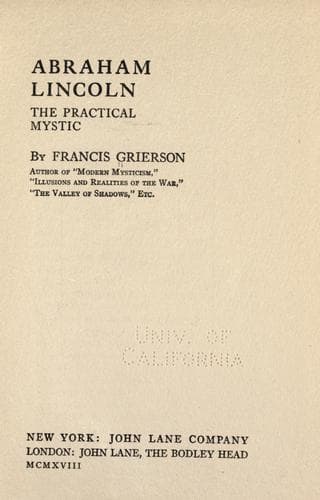
Abraham Lincoln: The Practical MysticGrierson, Francis
Religion
Abraham Lincoln: The Practical Mystic
Grierson, Francis
Lincoln, Abraham, 1809-1865 -- Psychology
_The Mystical Mood_
"There was to me," says Henry B. Rankin, in his "Personal Recollections
of Abraham Lincoln," "always an unapproachable grandeur in the man when
he was in this mood of inner solitude. It isolated and--I always
thought--exalted him above his ordinary life. History will discern and
reverently disclose the strength in Lincoln's character and the
executive foresight for which this mood gave him revealings."
And the Reverend Joseph Fort Newton adds to the sentiments of his friend
Rankin these words: "Lincoln was a man whom to know was a kind of
religion. His deep musings on the ways of God, on the souls of men, on
the principles of justice and the laws of liberty bore fruit in exalted
character and exact insight. Hence, a style of speech remarkable for its
lucidity, direction, and forthright power, with no waste of words,
tinged always by a temperament at once elusive and alluring, which Bryce
compares to the weighty eloquence of Cromwell without its haziness."
"_Going into the Silence_"
During an important criminal trial Amzi McWilliams said: "Lincoln will
pitch in heavy now for he has hid."
One who knew him declared: "He seemed never to be alone. I have
frequently seen him, in the midst of a Court in session, with his mind
completely withdrawn from the busy scene before his eyes, as completely
abstracted as if he were in absolute solitude."
Judge Whitney wrote: "In religion, Lincoln was in essence a mystic, and
all his adoration was in accordance with the tenets of that order," a
judgment which agrees with that of Alexander H. Stephens, Vice President
of the Southern Confederacy: "With Lincoln, the Union rose to the
sublimity of a religious Mysticism."
The mystical mood cannot be likened to any other mood. People in a hurry
never experience such a mental state. Personal ambition forbids it and
the feeling of vainglory renders such a condition impossible. What
renders the life of Lincoln so instructive is the fact that with him
everything was so natural. He did not experiment; he did not practise
special hours and seasons; he had no fixed times for this or that. He
professed no subtle methods of inducing moods and took no stimulants.
Nature and a mystical Providence arranged and provided.
His moods were between himself and his God. No one ever dared approach
him as to the why or the wherefore of his silence. And it is proper here
to comment on the instinctive good sense of the American people in whose
midst Lincoln passed his whole life--they instinctively knew too much to
presume upon the privacy of his mystical moods. In this their attitude
was wholly admirable. The American people were at that time practical,
democratic seers, without whom the greatest practical mystic could not
have existed.
Public-domain text, read in full here on John Shaqi.
Reviews
Reviews
No reviews yet
Be the first to share your thoughts on this work.
Join the Discussion
Join the discussion
Sign in to leave a comment or review.
Sign InorCreate an account