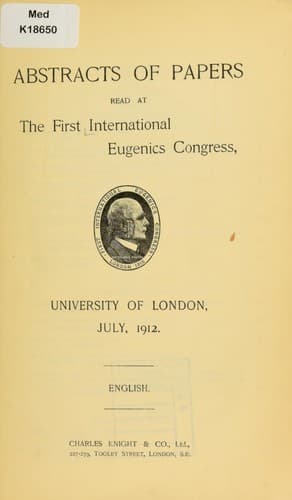
Abstracts of Papers Read at the First International Eugenics Congress: University of London, July, 1912 — John Shaqi
Abstracts of Papers Read at the First International Eugenics Congress: University of London, July, 1912International Eugenics Congress (1st : 1912 : London)
Science
Abstracts of Papers Read at the First International Eugenics Congress: University of London, July, 1912
International Eugenics Congress (1st : 1912 : London)
Eugenics -- Congresses
_Professor of Statistics in the Royal University of Cagliari, Italy._
Tables of mortality relating to human beings with classification as
to age, when compared with similar statistics relating to the equine
species, show that man during the period of development has a much
heavier death-rate. It is not possible to say whether in their natural
state the higher kinds of animals possess a higher or lower death-rate
during the period of development than when under domestication, but
the second of the alternatives seems more likely. It remains to be
determined whether the heavy death-rate during development which
the human race shows in the comparison is a distinctive natural
characteristic belonging to it, or whether it is rather the result of
the more or less artificial circumstances in which man is born and
reared.
The human race differs as regards reproduction and the rearing of its
offspring from the higher species of animals in their natural state,
chiefly in three ways: (_a_) In the case of the human race reproduction
takes place at all times of the year, whilst the higher animals have
one single period for reproducing, or, in some cases, two or three
periods; (_b_) animals reproduce as soon as the organism becomes
capable of reproduction, whilst in civilised human races as a rule a
longer or shorter period elapses between the time when the individual
becomes capable of reproduction and the time he actually begins to
reproduce; (_c_) in civilised man the development of altruistic
sentiments protects weak and sickly persons from the eliminating action
of natural selection, and often enables them to take part in the
procreation of future generations.
The paper of A. has for its object to examine closely these three
arguments based upon very extensive data taken partly from demographic
statistics and partly from researches made personally by him or which
he caused to be made, especially in the Municipal Statistical Offices
of Rome and Cagliari, and in the Obstetrical Clinic of Bologna. The
principal results are here indicated.
A. The rule of a greater number of conceptions in Spring observed in
temperate regions suffers notable exceptions in tropical and arctic
regions. Hence there is a weakening of the idea that in it one should
recognise the atavistic heritage of a special season for reproduction
which the human race had originally shown, analogous to what one finds
to-day in many species of animals. On the other hand, neither the
frequency of multiple births, of miscarriages, or of stillbirths, nor
the length of life of offspring nor their intellectual capacity show
any correlation whatever with the season of conception. The frequency
of stillbirths, however, and the length of life of the offspring show
a clear correlation with the season of birth, in the sense that those
born in temperate seasons show a lower rate for stillbirths and a
greater length of life.
Public-domain text, read in full here on John Shaqi.
Reviews
Reviews
No reviews yet
Be the first to share your thoughts on this work.
Join the Discussion
Join the discussion
Sign in to leave a comment or review.
Sign InorCreate an account