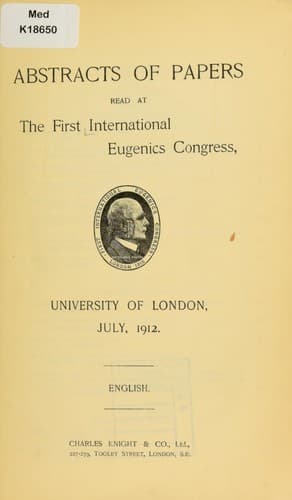
Abstracts of Papers Read at the First International Eugenics Congress: University of London, July, 1912International Eugenics Congress (1st : 1912 : London)
Science
Abstracts of Papers Read at the First International Eugenics Congress: University of London, July, 1912
International Eugenics Congress (1st : 1912 : London)
Eugenics -- Congresses
B. The age of the mother at the time of parturition does not show any
regular influence on the size and weight of the child. It has a very
sensible influence on the frequency of miscarriages and of stillbirths;
this increases with the increase in age. The age of the mother at the
time of marriage exercises a decisive influence upon the vitality
of the offspring: the greater the age of the mother at the time of
marriage the less will be the vitality of the children.
The age of the father at the birth of his child has some influence on
the number of stillbirths among his children. This influence--at any
rate above a given age--increases with the increase in the father's
age. It can neither be disproved nor affirmed that the age of the
father at the time of marriage has an influence upon the vitality of
the children; it is certain, however, that if any influence of that
kind exists it is much less intense than that exercised by the age of
the mother.
There has also been an enquiry as to the effect upon the characters of
the offspring exerted by (1) order of birth; (2) difference in age of
the parents; and (3) the age of the woman at the first menstruation.
C. Persons who die at a more advanced age have children in greater
number and endowed with greater length of life. For some classes of the
unfit (mad, consumptives, suicides) it can be proved beyond question
that the number of children born is less and their mortality greater
than among married people generally. Those who die of heart disease or
of cancer show a number of children slightly higher than the general
average of married persons; but that can be attributed to the fact that
their age at death is greater than the average age at death of married
people.
MATERNITY STATISTICS OF THE STATE OF RHODE ISLAND, STATE CENSUS OF 1905.
(Abstract.)
By Frederick L. Hoffman, LL.D., F.S.S.,
_Statistician of the Prudential Insurance Company of America._
As a contribution to the practical study of eugenics the decennial
maternity statistics of Rhode Island are of exceptional interest and
importance.
In 1905, of 36,766 native-born married women 26,329 (71.6%) were
mothers, and 10,477 (28.4%) childless. Of 32,960 foreign-born married
women 27,207 (82.5%) were mothers, and 5,753 (17.5%) childless.
Contrasting these percentages, the fact requires only to be stated to
emphasize its profound and far-reaching social as well as political
significance.
Considered with reference to religious belief, 72.7% of Protestant and
80.3% of Roman Catholic married women were mothers. Of married women of
Jewish faith 88.0% were mothers.
At ages 25-34, the proportion of native-born mothers having only one
child was 35.1%, against 22.6% for the foreign-born; the proportion of
mothers having from six to ten children was 6.8% for the native-born,
against 12.9% for the foreign-born. At all ages a similar disproportion
is apparent.
Public-domain text, read in full here on John Shaqi.
Reviews
Reviews
No reviews yet
Be the first to share your thoughts on this work.
Join the Discussion
Join the discussion
Sign in to leave a comment or review.
Sign InorCreate an account