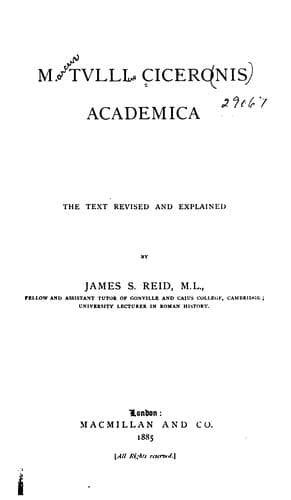
Knowledge, Theory of -- Early works to 1800; Philosophy -- Early works to 1800
The text is quite right, _ne quidem_, as Halm remarks, implies
no more than the Germ. _auch nicht_, cf. also Gk. ουδε. _Suscipiatur
labor_: MSS. om. the noun, but it is added by a later hand in G.
§6. _Epicurum, id est si Democritum_: for the charge see _D.F._ I. 17, IV.
13, _N.D._ I. 73. _Id est_ often introduces in Cic. a clause which
intensifies and does not merely explain the first clause, exx. in _M.D.F._
I. 33. _Cum causas rerum efficientium sustuleris_: cf. _D.F._ I. 18, the
same charge is brought by Aristotle against the Atomists, _Met._ A, 2. Many
editors from Lamb. to Halm and Baiter read _efficientis_, which would then
govern _rerum_ (cf. _D.F._ V. 81, _De Fato_, 33, also Gk. ποιητικος). But
the genitive is merely one of definition, the _causae_ are the _res
efficientes_, for which cf. 24 and _Topica_, 58, _proximus locus est rerum
efficientium, quae causae appellantur_. So Faber, though less fully.
_Appellat_: i.e. Amafinius, who first so translated ατομος. _Quae cum
contineantur_: this reading has far the best MSS. authority, it must be
kept, and _adhibenda etiam_ begins the _apodosis_. Madvig (_Emendationes ad
Ciceronis Libros Philosophicos_, Hauniae, 1825, p. 108) tacitly reads
_continentur_ without _cum_, so Orelli and Klotz. Goer. absurdly tries to
prop up the subj. without _cum_. _Quam quibusnam_: Durand's em. for
_quoniam quibusnam_ of the MSS., given by Halm and also Baiter. Madv.
(_Em._ p. 108) made a forced defence of _quoniam_, as marking a rapid
transition from one subject to another (here from physics to ethics) like
the Gk. επει, only one parallel instance, however, was adduced (_T.D._ III.
14) and the usage probably is not Latin. _Adducere?_: The note of
interrogation is Halm's; thus the whole sentence, so far, explains the
difficulty of setting forth the true system of physics. If _quoniam_ is
read and no break made at _adducere_, all after _quoniam_ will refer to
ethics, in that case there will be a strange change of subject in passing
from _quisquam_ to _haec ipsa_, both which expressions will be nominatives
to _poterit_, further, there will be the almost impossible ellipse of
_ars_, _scientia_, or something of the kind after _haec ipsa_. On every
ground the reading of Madv. is insupportable. _Quid, haec ipsa_: I have
added _quid_ to fill up the lacuna left by Halm, who supposes much more to
have fallen out. [The technical philosophical terms contained in this
section will be elucidated later. For the Epicurean ignorance of geometry
see note on II. 123] _Illi enim simpliciter_: "frankly," cf. _Ad Fam._
VIII. 6, 1 _Pecudis et hominis_: note on II. 139.
Public-domain text, read in full here on John Shaqi.
Reviews
Reviews
No reviews yet
Be the first to share your thoughts on this work.
Elsewhere in the archive
Join the Discussion
Join the discussion
Sign in to leave a comment or review.
Sign InorCreate an account