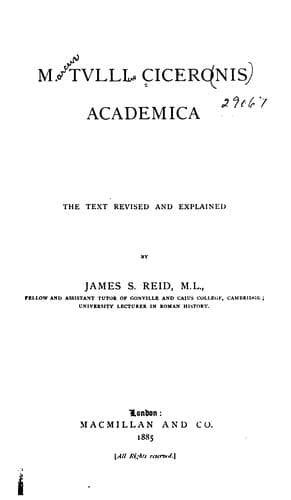
Knowledge, Theory of -- Early works to 1800; Philosophy -- Early works to 1800
of the usage, he forbears however, to
produce them. _Recondit_: so the εννοιαι are called αποκειμεναι νοησεις
(Plut. _De Sto. Repug._ p. 1057 a). In Sext. _Adv. Math._ VII. 373 μνημη is
called θησαυρισμος φαντασιων. _Similitudinibus_: καθ' ‛ομοιωσιν Sext.
_Pyrr. Hyp._ II. 75. Cic. uses this word as including all processes by
which the mind gets to know things not immediately perceived by sense. In
_D.F._ III. 33 it receives its proper meaning, for which see Madv. there,
and the passages he quotes, "analogies" will here best translate the word,
which, is used in the same wide sense in _N.D._ II. 22 38. _Construit_: so
MSS. Orelli gave _constituit_. _Notitiae_: cf. 22. Cic. fails to
distinguish between the φυσικαι εννοιαι or κοιναι which are the προληψεις,
and those εννοιαι which are the conscious product of the reason, in the
Stoic system. Cf. _M.D.F._ III. 21, V. 60, for this and other inaccuracies
of Cic. in treating of the same subject, also Zeller 79. _Rerumque_:
"facts". _Perfecta_: _sapientia_, _virtus_, _perfecta ratio_, are almost
convertible terms in the expositions of Antiocheanism found in Cic. Cf. I.
20.
§31. _Vitaeque constantiam_: which philosophy brings, see 23.
_Cognitionem_: επιστημην. _Cognitio_ is used to translate καταληψις in
_D.F._ II. 16, III. 17, cf. n. on I. 41. _Ut dixi ... dicemus_: For the
repetition cf. 135, 146, and _M.D.F._ I. 41. The future tense is odd and
unlike Cic. Lamb. wrote _dicimus_, I would rather read _dicamus_; cf. n. on
29. _Per se_: καθ' αυτην, there is no need to read _propter_, as Lamb. _Ut
virtutem efficiat_: note that virtue is throughout this exposition treated
as the result of the exercise of the _reason_. _Evertunt_: cf. _eversio_ in
99. _Animal ... animo_: Cic. allows _animus_ to all animals, not merely
_anima_; see Madv. _D.F._ V. 38. The rule given by Forc. s.v. _animans_ is
therefore wrong. _Temeritate_: προπετεια, which occurs _passim_ in Sext.
The word, which is constantly hurled at the dogmatists by the sceptics, is
here put by way of retort. So in Sext. _Adv. Math._ VII. 260, the sceptic
is called εμβροντητος for rejecting the καταληπτικη φαντασια.
Public-domain text, read in full here on John Shaqi.
Reviews
Reviews
No reviews yet
Be the first to share your thoughts on this work.
Elsewhere in the archive
Join the Discussion
Join the discussion
Sign in to leave a comment or review.
Sign InorCreate an account