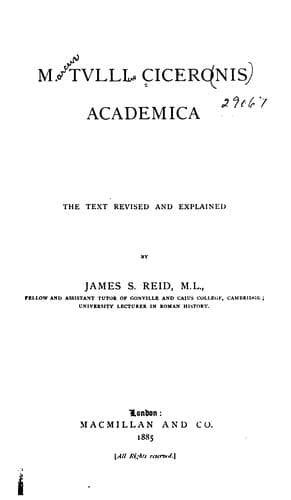
Knowledge, Theory of -- Early works to 1800; Philosophy -- Early works to 1800
§32. _Incerta_: αδηλα. _Democritus_: cf. I. 44. _Quae ... abstruserit_:
"_because_ she has hidden." _Alii autem_: note the ellipse of the verb, and
cf. I. 2. _Etiam queruntur_: "actually complain;" "go so far as to
complain." _Inter incertum_: cf. Numenius in Euseb. _Pr. Ev._ XIV. 7, 12,
διαφοραν ειναι αδηλου και ακαταληπτου, και παντα μεν ειναι ακαταληπτα ου
παντα δε αδηλα (quoted as from Carneades), also 54 of this book. _Docere_:
"to prove," cf. n. on 121. _Qui haec distinguunt_: the followers of
Carneades rather than those of Arcesilas; cf. n. on I. 45. _Stellarum
numerus_: this typical uncertainty is constantly referred to in Sext. e.g.
_P.H_. II. 90, 98, _A.M_. VII. 243, VIII. 147, 317; where it is reckoned
among things αιωνιον εχοντα αγνωσιαν. So in the Psalms, God only "telleth
the number of the stars;" cf. 110. _Aliquos_: contemptuous; απονενοημενους
τινας. Cf. _Parad._ 33 _agrestis aliquos_. _Moveri_: this probably refers
to the speech of Catulus; see Introd. p. 51. Aug. _Cont. Ac._ III. 15
refers to this passage, which must have been preserved in the second
edition.
§33. _Veri et falsi_: these words Lamb. considered spurious in the first
clause, and Halm brackets; but surely their repetition is pointed and
appropriate. "You talk about a rule for distinguishing between the true and
the false while you do away with the notion of true and false altogether."
The discussion here really turns on the use of terms. If it is fair to use
the term "true" to denote the _probably true_, the Academics are not open
to the criticism here attempted; cf. 111 _tam vera quam falsa cernimus_.
_Ut inter rectum et pravum_: the sceptic would no more allow the absolute
certainty of this distinction than of the other. _Communis_: the
απαραλλακτος of Sextus; "in whose vision true and false are confused." Cf.
κοινη φαντασια αληθους και ψευδους Sext. _A.M._ VII. 164 (R. and P. 410),
also 175. _Notam_: the σημειον of Sextus; cf. esp. _P.H_. II. 97 sq. _Eodem
modo falsum_: Sext. _A.M._ VII. 164 (R. and P. 410) ουδεμια εστιν αληθης
φαντασια ‛οια ουκ αν γενοιτο ψευδης. _Ut si quis_: Madv. in an important n.
on _D.F._ IV. 30 explains this thus; _ista ratione si quis ... privaverit,
possit dicere_. I do not think our passage at all analogous to those he
quotes, and still prefer to construe _quem_ as a strong relative, making a
pause between _quis_ and _quem_. _Visionem_: Simply another trans. of
φαντασια. _Ut Carneades_: see Sext. _A.M._ VII. 166 την τε πιθανην
φαντασιαν και την πιθανην ‛αμα και απερισπαστον και διεξωδευμενην (R. and
P. 411). As the trans. of the latter phrase in Zeller 524 "probable
undisputed and tested" is imperfect, I will give Sextus' own explanation.
The merely πιθανη is that sensation which at first sight, without any
further inquiry, seems probably true (Sext. _A.M._ VII. 167--175). Now no
sensation is perceived _alone_; the percipient subject has always other
synchronous sensations which are able to turn him aside (περισπαν,
Public-domain text, read in full here on John Shaqi.
Reviews
Reviews
No reviews yet
Be the first to share your thoughts on this work.
Elsewhere in the archive
Join the Discussion
Join the discussion
Sign in to leave a comment or review.
Sign InorCreate an account