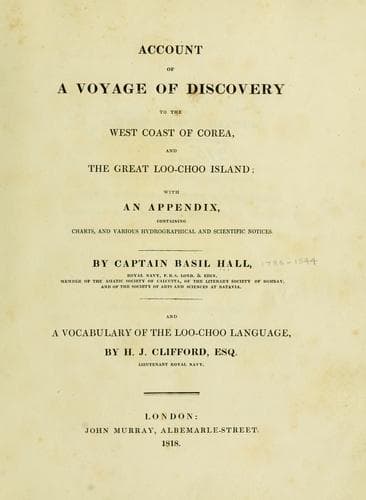
Account of a voyage of discovery to the west coast of Corea, and the great Loo-Choo IslandHall, Basil
History
Account of a voyage of discovery to the west coast of Corea, and the great Loo-Choo Island
Hall, Basil
Korea -- Description and travel; Ryukyu Islands -- Description and travel
Polygamy is not allowed in Loo-choo as in China, and the king, it
appears, is the only person permitted by law to have concubines; they
invariably spoke with horror of the Chinese practice, which allows a
plurality of wives, and were much gratified on learning that the English
customs in this respect were similar to those of Loo-choo. The women are
not treated so well as we were led to expect from the mildness of
character in the men, and their liberality of thinking in general. The
upper classes of women are confined a good deal to their houses, and the
lower orders perform much of the hard work of husbandry. We saw them at
a distance, in great numbers, carrying loads on their heads. Madera says
that the women are not treated with much indulgence, being even
restricted from using fans; and that when they are met out of doors by
the men, they take no notice of one another, whatever may be the degree
of relationship or intimacy subsisting between them. The perseverance
with which they kept the women from our sight is curious, and leads us
to conjecture that the general practice of the island is to seclude the
women at all times. In this respect they differ from the Japanese, who
are said to allow wives to every stranger. This degree of seclusion
does not prevail in China, as we had opportunities of observing at
several places never before visited by Europeans. The Chinese account
quoted in the Lettres Edifiantes et Curieuses, vol. 23, states that the
young men and women marry on this island by choice, and not, as in
China, by a contract made without any personal knowledge of each other.
We took every opportunity of interrogating them on this subject, but as
the question was always evaded, we fear that their practice in this
respect is not so praiseworthy as that account would make it appear.
Of their literature we could get but few satisfactory accounts; they say
that they have few books in their own language, the greater number on
the island being Chinese. The young men of rank are sometimes sent to
China to be educated. Jeeroo had been there when a boy. None but the
upper classes understand the spoken Chinese, and the peasantry are in
general ignorant both of the spoken and written Chinese language.
Public-domain text, read in full here on John Shaqi.
Reviews
Reviews
No reviews yet
Be the first to share your thoughts on this work.
Elsewhere in the archive
Join the Discussion
Join the discussion
Sign in to leave a comment or review.
Sign InorCreate an account