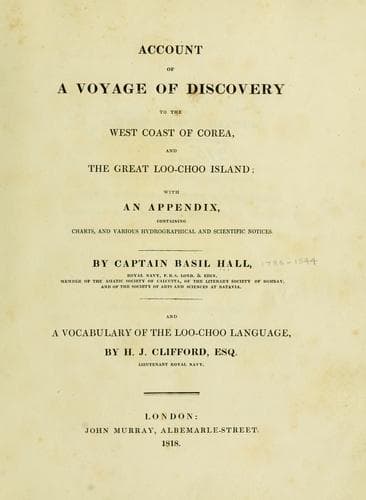
Account of a voyage of discovery to the west coast of Corea, and the great Loo-Choo IslandHall, Basil
History
Account of a voyage of discovery to the west coast of Corea, and the great Loo-Choo Island
Hall, Basil
Korea -- Description and travel; Ryukyu Islands -- Description and travel
They appear to have no money, and from all we could see or hear, they
are even ignorant of its use. Those, however, who have visited China
cannot be so ill informed, and yet none of them set any value upon
Spanish dollars, or upon any gold coins that we had. Though we were
incessantly trying to make out from Madera and the others, what their
medium of exchange was, we could never learn any thing distinct upon the
subject, nor could they be made to comprehend our questions about money;
a difficulty, it may be observed, which we should expect to meet with
among people whose only mode of purchase was by barter. The only
circumstance which came to our knowledge bearing at all upon this
question, was during the time when the garden was under preparation for
the reception of the Alceste's stores; it was then remarked that each of
the labourers employed had a little piece of paper stuck in his hair,
with a single character written on it; this naturally excited our
curiosity, but the inquiries we were enabled to make at that early stage
of our knowledge of the language, led to nothing conclusive. Afterwards,
when our means in this respect were more ample, we could not recall the
circumstance to the recollection of the chiefs. As these papers were
called by the people wearing them, "hoonatee," and as "hoonee" means
ship, Mr. Clifford has conjectured that they may have been written
passes to enable them to enter the gate on the ship's business.
We saw no arms of any kind, and the natives always declared that they
had none. Their behaviour on seeing a musket fired certainly implied an
ignorance of fire-arms. In a cottage at the north end of the island, we
saw a spear which had the appearance of a warlike weapon, but we had
every reason to believe that this was used for the sole purpose of
catching fish, having seen others not very dissimilar actually employed
in this way. They looked at our swords and cutlasses, and at the Malay
creeses and spears, with equal surprise, being apparently as little
acquainted with the one as with the other. The chiefs carried little
case knives in the folds of their robes, or in the girdle, and the lower
orders had a larger knife, but these were always of some immediate
practical utility, and were not worn for defence nor as ornaments. They
denied having any knowledge of war either by experience or by tradition.
We never saw any punishment inflicted at Loo-choo: a tap with the fan,
or an angry look, was the severest chastisement ever resorted to, as far
as we could discover. In giving orders, the chiefs were mild though
firm, and the people always obeyed with cheerfulness. There seemed to be
great respect and confidence on the one hand, and much consideration and
kind feeling on the other. In this particular, more than in any other
that fell under our notice, Loo-choo differs from China, for in the
latter country we saw none of this generous and friendly understanding
between the upper and lower classes.
Public-domain text, read in full here on John Shaqi.
Reviews
Reviews
No reviews yet
Be the first to share your thoughts on this work.
Elsewhere in the archive
Join the Discussion
Join the discussion
Sign in to leave a comment or review.
Sign InorCreate an account