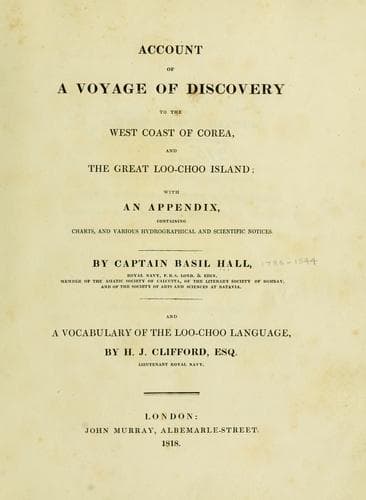
Account of a voyage of discovery to the west coast of Corea, and the great Loo-Choo IslandHall, Basil
History
Account of a voyage of discovery to the west coast of Corea, and the great Loo-Choo Island
Hall, Basil
Korea -- Description and travel; Ryukyu Islands -- Description and travel
One day when we were drinking tea and smoking pipes with the chiefs, on
the top of the hill, a boy began to exhibit feats of tumbling before us;
in a short time all eyes were turned towards him, and his modesty caused
him to desist. We offered him buttons and various things, but he would
not resume his tumbling: we then asked Jeema to interfere; he did so,
and told the youngster to go on; but he kept his seat, and Jeema became
angry, or rather pretended to be so, yet the tumbler sat obstinately
still. "Well," said Jeema to us, "what is to be done? It was for his own
amusement that he began, and probably for his amusement he will do so
again." The boy, when left alone, in a short time resumed his tumbling.
I mention this to shew Jeema's good sense in not forcing the boy to do
that as a task, which he had begun as an amusement, and which he had
discernment enough to know would be unpleasant for us to witness in any
other way. By this treatment of their children, mutual cordiality and
freedom of intercourse are encouraged. It was probably owing to this
mode of education that the children became at once familiar with us. One
day while I was employed sketching the village and trees near the
bridge, a boy stopped near me, and without saying any thing, endeavoured
to attract my notice by performing various gambols before me. I took no
notice of him for some time, but at last looked up and smiled; upon
which the boy cried out in perfectly good English, "How do you do? Very
well, I thank you;" and ran off, quite delighted at having displayed his
proficiency in English.
The chiefs were generally accompanied by one or two of their sons, who
took their places near them, and were always put forward when there was
any thing curious to be seen. In this way they were encouraged to make
themselves acquainted with every thing, and yet nothing could be more
respectful or affectionate than they always were. Great pains were taken
to form the manners of the children, and we never observed an instance
of rudeness in any one of them, though they were as full of life and
spirits as the wildest English school-boys. John the Chinaman afforded
them much amusement: he was a great coxcomb, and therefore fair game for
the boys; they used to surround him and pretend to pull his long tail;
but they never actually pulled it, but merely teazed him a little, and
then ran away. These little traits seem worthy of notice, as they belong
to a style of education quite different from what we had seen in China
and some other eastern countries, where the children are made to look
like men in miniature.
Public-domain text, read in full here on John Shaqi.
Reviews
Reviews
No reviews yet
Be the first to share your thoughts on this work.
Elsewhere in the archive
Join the Discussion
Join the discussion
Sign in to leave a comment or review.
Sign InorCreate an account