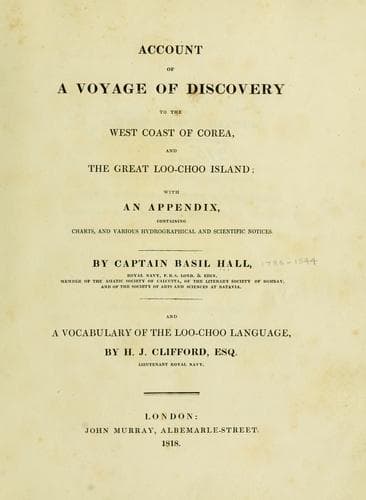
Account of a voyage of discovery to the west coast of Corea, and the great Loo-Choo IslandHall, Basil
History
Account of a voyage of discovery to the west coast of Corea, and the great Loo-Choo Island
Hall, Basil
Korea -- Description and travel; Ryukyu Islands -- Description and travel
The Loo-choo dress has been so frequently mentioned, that a brief
notice, in recapitulation, will suffice in this place. Their loose robe
was generally made of cotton, and of a great variety of colours. The
robe of a grown up person was never flowered or printed over with
figures, being generally of a uniform colour, though instances occurred
of striped cloths being worn by the chiefs. This robe opened in front,
but the edges overlapped, and were concealed by the folds, so as to
render it difficult to say whether or not the robe was continued all
round: the sleeves were about three feet wide: round the middle was
bound a belt or girdle about four or five inches wide, always of a
different colour from the dress, and in general richly ornamented with
wrought silk and gold flowers. The folds of the robe overhang the belt,
but not so much as to hide it: the whole of the dress folds easily, and
has a graceful and picturesque appearance. The garments worn by the
children were often gaudily printed with flowers. In rainy or cold
weather, a sort of great coat was worn by the chiefs only, of thick blue
cloth, buttoning in front over the robe, and tighter both in body and
sleeves than the other. This cloth resembled the coarse cloth used in
China; and it looked like woollen manufacture, and may possibly have
been originally brought from England. The sandals worn by all ranks were
exactly the same; they were formed of straw wrought into a firm mat to
fit the sole of the foot, smooth towards the foot, and ragged
underneath: a stiff smooth band of straw, about as thick as one's little
finger, passes from that part of the sandal immediately under the ancle
and over the lower part of the instep, so as to join the sandal at the
opposite side; this is connected with the foremost part of the sandal by
a short small straw cord which comes between the great toe and the
next one. The upper classes wore stockings of white cotton, not unlike
our half stockings, except that they button at the outside, and have a
place like the finger of a glove for the great toe.
[Illustration: GENTLEMAN of LOO CHOO in his CLOAK.]
Public-domain text, read in full here on John Shaqi.
Reviews
Reviews
No reviews yet
Be the first to share your thoughts on this work.
Elsewhere in the archive
Join the Discussion
Join the discussion
Sign in to leave a comment or review.
Sign InorCreate an account