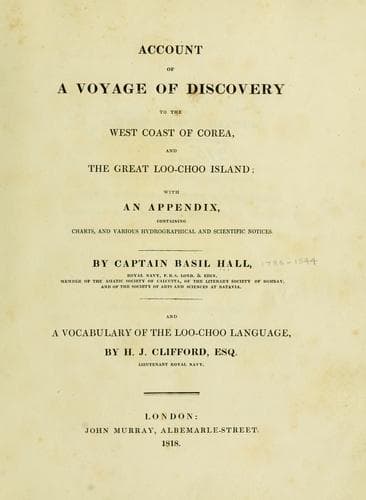
Account of a voyage of discovery to the west coast of Corea, and the great Loo-Choo IslandHall, Basil
History
Account of a voyage of discovery to the west coast of Corea, and the great Loo-Choo Island
Hall, Basil
Korea -- Description and travel; Ryukyu Islands -- Description and travel
Their hair is of a jet black, and is kept glossy by juice expressed
from a leaf. There is no variety in the fashion of dressing it; it is
pulled tight up all round, and is formed at top into a compact knot, so
as to conceal the crown of the head, which is shaved; through the knot
are thrust two metal pins, one of which has a square point and flowered
head consisting of six leaves or divisions: the other pin has one end
sharp, and the other shaped like a scoop: the length of these pins is
from four to six inches. We did not see the Prince's, as he remained
covered during all the time of his visit; but the Chief of high rank,
who visited the Alceste on the 23d of September, had the flowered end of
one pin studded with precious stones. The higher orders wear, on state
occasions, what they called a "hatchee-matchee," which is a kind of
turban, apparently made by winding a broad band round a cylinder, in
such a way, that a small segment of each fold is shewn at every turn, in
front above, and behind below; this is effected by giving a slight
diagonal direction to each fold. The lower orders occasionally tie a
coloured cloth or handkerchief round the head; this they call "sadjee:"
next the body they wear a thin cotton dress. The men wear no ornaments
through their flesh, nor are they tattooed: we saw, indeed, some
fishermen who had fish spears marked on their arms, but this does not
prevail generally. An etching of these marks is given by Mr. Clifford in
the second part of the Vocabulary.
The cattle on this island, which are of a small black breed, are used
exclusively for agricultural purposes. Hogs, goats, and poultry, with
rice and a great variety of vegetables, form the food of the
inhabitants: milk is never used. We saw no geese, so that those left by
Captain Broughton most probably did not thrive. They have no sheep nor
asses. Their horses are of a small slight make, and the natives are very
fond of riding. We saw no carts or wheeled carriages of any kind, horses
being used to carry loads; for this purpose the roads are numerous, and
kept in excellent order, being from six to ten feet wide.
Public-domain text, read in full here on John Shaqi.
Reviews
Reviews
No reviews yet
Be the first to share your thoughts on this work.
Elsewhere in the archive
Join the Discussion
Join the discussion
Sign in to leave a comment or review.
Sign InorCreate an account