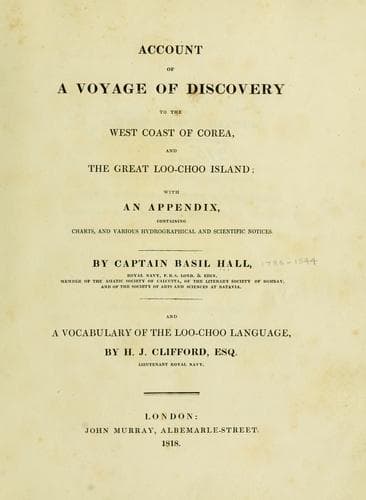
Account of a voyage of discovery to the west coast of Corea, and the great Loo-Choo IslandHall, Basil
History
Account of a voyage of discovery to the west coast of Corea, and the great Loo-Choo Island
Hall, Basil
Korea -- Description and travel; Ryukyu Islands -- Description and travel
10. Dyke, porphyritic granite, composed of white quartz, white feldspar,
and bronze-coloured mica. This dyke cuts across the schistus last
mentioned, in a direction north-east and south-west. It is nearly
vertical, and varies in breadth from nine to forty feet, with numerous
ramifications.
11. Dyke of compact whin stone. This dyke is composed of five layers of
prisms, whose length is at right angles to the walls of the dyke. It is
nearly vertical. Its direction north and south, and is about five feet
thick.
MAIN LAND OF COREA.
12. Lead-coloured, fine-grained, micaceous schistus. From the main land
of Corea, latitude 36º 10' north, longitude 126º 48' east. The strata
lie north-west and south-east, and are nearly vertical; the natives
objected to our examining the cliffs, though distant less than a quarter
of a mile from the beach.
ANOTHER ISLAND OFF THE COAST OF COREA.
Latitude 34º 23' north, longitude 126º east.
13. Decomposing fine-grained rock; composed of flesh-coloured feldspar,
white quartz, and porcelain clay.
ANOTHER ISLAND NEAR THE ABOVE.
14. Rock composed of white feldspar and quartz. The strata of this rock
were very much contorted.
This rock is the most general of any in this range of islands, at least
as far as we had opportunities of examining them. The islands on this
coast are very numerous; they lie in great clusters along a line of
three degrees and a half of latitude. The islands vary in length from
five or six miles to as many yards, and are of all forms. We saw none
that were remarkably high, and none which seemed volcanic. As our stay
on the coast was only nine days, and as the ships were almost always
under weigh except at night, it was quite impossible to make any careful
or valuable geological observations. It offers a splendid field to
future voyagers.
GREAT LOO-CHOO ISLAND.
1. Grey stratified lime-stone without shells. This specimen was taken
from the north end of the island, where the ranges of hills were mostly
composed of it: the strata being highly inclined. The hills rise to the
height of four or five hundred feet, and present nothing interesting.
2. Fawn-coloured, cellular, granular lime-stone. The cliffs at Napakiang
are composed of this rock; it also appears to stretch along the whole of
the south-west and south parts of the coast. In the narrative, this rock
has been erroneously called coral. These cliffs are curiously hollowed
out into horizontal caves, which have all the appearance of having been
worn by the dashing of the waves; but as it is obvious, that in their
present situation the sea can never have reached the face of the cliffs,
it seems probable that the whole coast may have been raised up, by a
gentle movement, without dislocating the strata, or disturbing the
horizontal position, in which it seems probable that these caves were
formed.
Public-domain text, read in full here on John Shaqi.
Reviews
Reviews
No reviews yet
Be the first to share your thoughts on this work.
Elsewhere in the archive
Join the Discussion
Join the discussion
Sign in to leave a comment or review.
Sign InorCreate an account