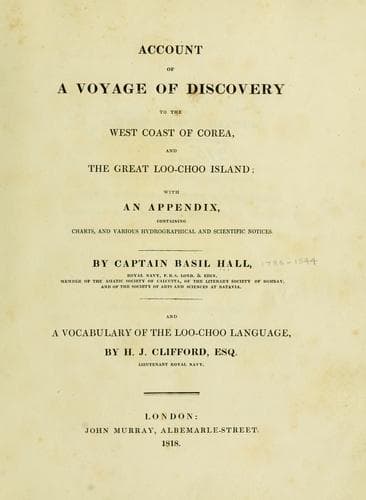
Account of a voyage of discovery to the west coast of Corea, and the great Loo-Choo IslandHall, Basil
History
Account of a voyage of discovery to the west coast of Corea, and the great Loo-Choo Island
Hall, Basil
Korea -- Description and travel; Ryukyu Islands -- Description and travel
January Shaw gwautsee.
February Nee gwautsee (lit. 2d month).
March Sang gwautsee (lit. 3d).
April Shee gwautsee (lit. 4th).
May Goo gwautsee (lit. 5th).
June Roocoo gwautsee (lit. 6th).
July Sitchee gwautsee (lit. 7th).
August Fatchee gwautsee (lit. 8th).
September Coo gwautsee (lit. 9th).
October Joo gwautsee (lit. 10th).
November Shee moo stitchee, or joo itchee gwautsee.
December Shee wasee, or joo nee gwautsee.
The twentieth day of the tenth month (October), _Joo gwautsee, neejoo
nitchee_, was, according to Loo-Choo time, the second day of the tenth
month, _joo gwautsee, nee nitchee_.]
[Footnote 84: A strong aspirate on the first syllable.]
[Footnote 85: The negative is almost invariably placed after the word.]
[Footnote 86: See note on numerals.]
[Footnote 87: The sound of the _oong_, or _oomb_, is very difficult, and
can only be approximated by closing the teeth firmly and compressing the
sound of _oong_.]
[Footnote 88: See note on Numerals.]
[Footnote 89: See Sentences Nos. 49 to 53.]
[Footnote 90: _Sheenoostang_ signifies to _cover over_, and possibly
_ooroo_ should have been written _eeroo_, which is _colour_; and this
word, signifying _painting_, would then be literally _to cover over with
colour_.]
[Footnote 91: This is literally the _belly of the hand_, or the _hand's
belly_. For an explanation of the _noo_ see observations on the Loo-Choo
language at the beginning.]
[Footnote 92: This word seems to derive its origin from _ackka_,
_burning_.]
[Footnote 93: This word, _Katcheemeeoong_, to pinch, appears to be
formed of the words _Ka_, skin, _chee_, blood, and _meeoong_, to see;
and may be translated to _see the blood through the skin_, or _in the
skin_.]
[Footnote 94: This sound is not unlike that which the screwing about the
scull of a boat on the pivot causes.]
[Footnote 95: The same word signifies a flower.]
[Footnote 96: _Feetchoong_ signifies to pull, so that it may with more
propriety be applied to the harp, or touching the strings of the violin
with the fingers.]
[Footnote 97: A strong aspirate on the last syllable.]
[Footnote 98: See Sentence No. 105.]
[Footnote 99: Literally, to upset.]
[Footnote 100: For the sound of this word see note on the English word
_no_.]
[Footnote 101: See Sentence No. 8.]
[Footnote 102: _Narang_, or _nang_, is used on most occasions as the
negative.]
[Footnote 103: The same word signifies _sweet potatoes_.]
[Footnote 104: This word it will be observed signifies both _to screw_
and _to scull;_ this may originate in the screwing motion of the oar
from side to side of the boat.]
[Footnote 105: See Sentences No. 38 to 44.]
Public-domain text, read in full here on John Shaqi.
Reviews
Reviews
No reviews yet
Be the first to share your thoughts on this work.
Elsewhere in the archive
Join the Discussion
Join the discussion
Sign in to leave a comment or review.
Sign InorCreate an account