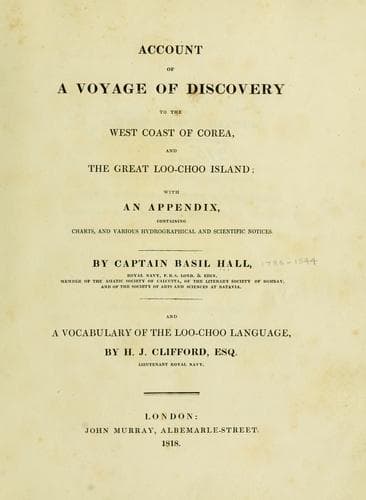
Account of a voyage of discovery to the west coast of Corea, and the great Loo-Choo IslandHall, Basil
History
Account of a voyage of discovery to the west coast of Corea, and the great Loo-Choo Island
Hall, Basil
Korea -- Description and travel; Ryukyu Islands -- Description and travel
[Footnote 106: The similarity in sound of this word to that of a
character (_Hoonatee_) written on a piece of paper in the hats of the
men employed working for the ships, has suggested the idea that the
meaning of the character may have some reference to a ship.]
[Footnote 107: See Sentences Nos. 102 and 103.]
[Footnote 108: Words of Loo-Choo songs:
"Sasa sangcoomeh sangcoomeah kadee yooshee daw, tantoong tantoong tang."
A boat song: "Whee yo ee.--Whee yo ee." The steersman gave "Whee," and
was followed by the other men with a repetition of "Whee yo ee."
Another boat song: "Quee yay hanno ha.--Quee yay hanno ha." To both
these airs the rowers kept very good time.]
[Footnote 109: See Sentences Nos. 1 to 7.]
[Footnote 110: The _kawroo_ is a small square stone excavated a little
on the upper part, in which an offering of rice is made. On the face of
this stone is carved a variety of characters denoting the rank, &c. of
the person who makes the offering.]
[Footnote 111: See Sentences in Part II.]
[Footnote 112: See Sentences Nos. 29, 32, 33, and 37.]
[Footnote 113: See Sentences Nos. 108, 109, and 110.]
[Footnote 114: _Amazackkee_ is a contraction of the words _amasa_,
sweet, and _sackkee_, wine; the latter always changing _s_ into _z_ when
preceded by any other word. See _wine_, _strong_, _weak_, &c.]
[Footnote 115: Tattoo marks will be found in Part II.]
[Footnote 116: _Eechoo._ This word is used to denote _thread_, silk_,
and _ribbon._]
[Footnote 117: _Ootchoong_, or _oochoong_, signifies _to work_, _to
play_, and _to make_.]
[Footnote 118: Possibly this word implies the act of swallowing.]
[Footnote 119: The sound of this word is precisely the same as that of
our _tobacco_. I have, therefore, spelt it in the same manner.]
[Footnote 120: See Sentence No. 109.]
[Footnote 121: See Sentences Nos. 45, 47, and 48.]
[Footnote 122: This is probably the _tae fung_ (great wind of the
Chinese, called by us _tyfoon_), a severe gale of wind in the China
Sea.]
[Footnote 123: See Sentence No. 73.]
[Footnote 124: The year at Loo-Choo, according to Jeeroo's account, is
divided into twelve months of thirty days each, making in all 360 days,
and every sixth year one month is intercalated.]
NOTE.
In the following Sentences the English is given before the Loo-Choo. No
Sentence has been inserted the meaning of which was not distinctly
ascertained; but it happened frequently that the precise import of some
words in a Sentence was not made out, and in order to enable the reader
to judge to what extent this took place, a literal translation of the
words in each Sentence is given in the last column; and where a word
occurs, the meaning of which is doubtful, an asterisk is put in its
place.
In the last column it will be observed that every verb having the
termination _oong_, _ung_, &c. is translated as if it were the
infinitive, although the sense, as denoted in the first column, points
to another mood.
SENTENCES, ENGLISH AND LOO-CHOO.
Public-domain text, read in full here on John Shaqi.
Reviews
Reviews
No reviews yet
Be the first to share your thoughts on this work.
Elsewhere in the archive
Join the Discussion
Join the discussion
Sign in to leave a comment or review.
Sign InorCreate an account