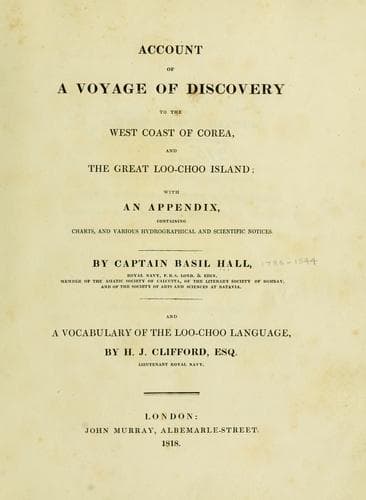
Account of a voyage of discovery to the west coast of Corea, and the great Loo-Choo IslandHall, Basil
History
Account of a voyage of discovery to the west coast of Corea, and the great Loo-Choo Island
Hall, Basil
Korea -- Description and travel; Ryukyu Islands -- Description and travel
H.M.S. Alceste and Lyra leave the Yellow Sea on a Voyage of
Discovery--Sir James Hall's Group on the Coast of Corea--Unsociable
Character of the Natives--Hutton's Island--Interesting geological
Structure--Anchor near the Main Land--Corean Chiefs
Visit--Objections made to Strangers landing--Distress of the
Chief--His Character--Departure from Basil's Bay--Clusters of
Islands--Murray's Sound--Deserted Corean Village--View from the
Summit of a high Peak--Interview with the Coreans--Peculiarities of
their Character--Language--Erroneous geographical Position of this
Coast--Leave Corea.
The embassy to China, under the Right Honourable Lord Amherst, left
England in his Majesty's frigate Alceste, Captain Murray Maxwell, C.B.,
on the 9th of February, 1816, and landed near the mouth of the Pei-ho
river, in the Yellow Sea, on the 9th of August. Shortly afterwards the
Alceste and Lyra sloop of war, which had accompanied the embassy,
proceeded to the coast of Corea, the eastern boundary of the Yellow Sea;
for as these ships were not required in China before the return of the
Embassador by land to Canton, it was determined to devote the interval
to an examination of some places in those seas, of which little or no
precise information then existed. The following pages give the details
of this voyage.
1st of September.--This morning at daylight the land of Corea was seen
in the eastern quarter. Having stood towards it, we were at nine o'clock
near three high islands, differing in appearance from the country we had
left, being wooded to the top, and cultivated in the lower parts, but
not in horizontal terraces as at the places we had last visited in
China. We proceeded to the southward of the group, and anchored in a
fine bay at the distance of two or three miles from the southern island.
Shortly after anchoring, a boat came from the shore with five or six
natives, who stopped, when within fifty yards of the brig, and looking
at us with an air of curiosity and distrust, paid no attention to the
signs which were made to induce them to come alongside. They expressed
no alarm when we went to them in our boat; and on our rowing towards the
shore, followed us till we landed near a village. The inhabitants came
in a body to meet us, forming an odd assemblage, different in many
respects from any thing we had seen; their colour was a deep copper, and
their appearance forbidding, and somewhat savage. Some men, who appeared
to be superior to the rest, were distinguished by a hat, the brim of
which was nearly three feet in diameter, and the crown, which was about
nine inches high, and scarcely large enough to admit the top of the
head, was shaped like a sugar-loaf with the end cut off. The texture of
this strange hat is of a fine open work like the dragon-fly's wing; it
appears to be made of horse-hair varnished over, and is fastened under
the chin by a band strung with large beads, mostly black and white, but
Public-domain text, read in full here on John Shaqi.
Reviews
Reviews
No reviews yet
Be the first to share your thoughts on this work.
Join the Discussion
Join the discussion
Sign in to leave a comment or review.
Sign InorCreate an account