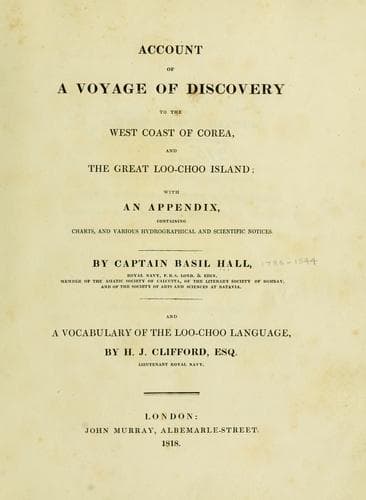
Account of a voyage of discovery to the west coast of Corea, and the great Loo-Choo IslandHall, Basil
History
Account of a voyage of discovery to the west coast of Corea, and the great Loo-Choo Island
Hall, Basil
Korea -- Description and travel; Ryukyu Islands -- Description and travel
occasionally red or yellow. Some of the elderly men wore stiff gauze
caps over their hair, which was formed into a high conical knot on the
top of the head. Their dress consisted of loose wide trowsers, and a
sort of frock reaching nearly to the knee, made of a coarse open grass
cloth, and on their feet neat straw sandals. They were of the middle
size, remarkably well made, and robust looking. At first they expressed
some surprise on examining our clothes, but afterwards took very little
interest in any thing belonging to us. Their chief anxiety was to get
rid of us as soon as possible. This they expressed in a manner too
obvious to be mistaken; for, on our wishing to enter the village, they
first made motions for us to go the other way; and when we persevered,
they took us rudely by the arms and pushed us off. Being very desirous
to conciliate them, we shewed no impatience at this treatment; but our
forbearance had no effect; and after a number of vain attempts to make
ourselves understood, we went away not much pleased at their behaviour.
A Chinese[1], who accompanied us, was of no use, for he could not read
what the Coreans wrote for him, though in the Chinese character; and of
their spoken language he did not understand a word.
On leaving these unsociable villagers, we went to the top of the highest
peak on the island, the ascent being easy by a winding foot-path. From
this elevation we saw a number of islands to the eastward, and the main
land at a great distance beyond them. The top of the hill being covered
with soft grass and sweet-smelling shrubs, and the air, which had been
of a suffocating heat below, being here cool and refreshing, we were
tempted to sit down to our pic-nic dinner. We returned by the other side
of the hill; but there being no path, and the surface rocky and steep,
and covered with a thick brushwood, we were not a little scratched and
bruised before we reached a road which runs along the north face of the
hill about midway. By following this, we came to a spot from whence we
were enabled to look down upon the village, without being ourselves
perceived by the natives. The women, who had deserted the village on
our landing, had now returned; most of them were beating rice in wooden
mortars, and they had all children tied on their backs. On a sudden they
quitted their work and ran off to their huts, like rabbits in a warren;
and in a few minutes we saw one of the ship's boats row round the point
of land adjacent to the village, which explained the cause of their
alarm. After remaining for some time in expectation of seeing the women
again, we came down to the village, which the natives now permitted us
to pass through. On this occasion one of the gentlemen of our party saw,
for an instant, a woman at no great distance, whose feet he declared
were of the natural size, and not cramped as in China. The village
consists of forty houses rudely constructed of reeds plaistered with
Public-domain text, read in full here on John Shaqi.
Reviews
Reviews
No reviews yet
Be the first to share your thoughts on this work.
Join the Discussion
Join the discussion
Sign in to leave a comment or review.
Sign InorCreate an account