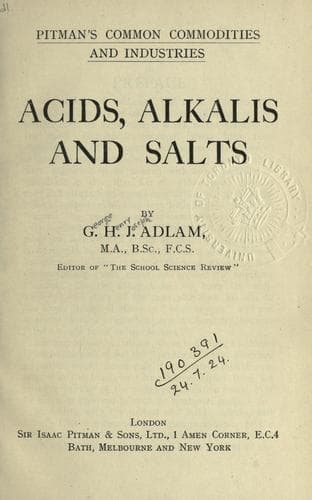
Acids, Alkalis and SaltsAdlam, George Henry Joseph
Science
Acids, Alkalis and Salts
Adlam, George Henry Joseph
Acids; Alkalies; Salts
It is not known with any degree of certainty how the nitric acid acts in
bringing about this remarkable change. It has been suggested that
reduction to nitrogen peroxide first takes place, and that sulphur
dioxide takes oxygen from this body, reducing it still further to nitric
oxide, which at once combines with the free oxygen present to form
nitrogen peroxide again. So the cycle of changes goes on, the nitrogen
peroxide playing the part of oxygen carrier to the sulphur dioxide; and
since it is continually regenerated, it remains at the end mixed with
the residual gases.
Recovery of the Nitrogen Peroxide. If the gases from the last chamber
passed directly into the chimney shaft, there would be a total loss of
the oxides of nitrogen, and the consequence of this would be that more
than 2 cwt. of nitre would have to be used for the production of 1 ton
of sulphuric acid. This would be a serious item in the cost of
production, and it is therefore essential that this loss should be
prevented.
The recovery of the oxides of nitrogen is effected in the Gay Lussac
tower, a structure about 50 ft. in height, built of sheet lead and lined
with acid-resisting brick. It is filled with flints, over which a slow
stream of cold concentrated sulphuric acid is delivered from a tank at
the top. As the gas from the last chamber passes up this tower, it meets
the stream of acid coming down. This dissolves and retains the nitrogen
peroxide. The acid which collects at the bottom of the tower is known as
nitrated vitriol.
The next step is to bring the recovered nitrogen peroxide again into
circulation. The nitrated vitriol is raised by compressed air to the top
of the Glover tower, and as it trickles down over the flints in this
tower it is diluted with water, while at the same time it meets the hot
gases coming from the pyrites burners. Under these conditions, the
nitrogen peroxide is liberated and carried along by the current of gas
into the first lead chamber. The stream of cold acid coming down the
Glover tower also serves to cool the hot gases before they enter the
first chamber.
In order to complete the description of the works, it is necessary to
add a note on the lead chambers themselves. The sheet lead used in their
construction is of a very substantial character; it weighs about 7 lb.
per square foot. The separate strips are joined together by autogenous
soldering, that is, by fusing the edges together. In this way the
presence of another metal is avoided; otherwise this would form a
voltaic couple with the lead, and rapid corrosion would take place.
Public-domain text, read in full here on John Shaqi.
Reviews
Reviews
No reviews yet
Be the first to share your thoughts on this work.
Join the Discussion
Join the discussion
Sign in to leave a comment or review.
Sign InorCreate an account