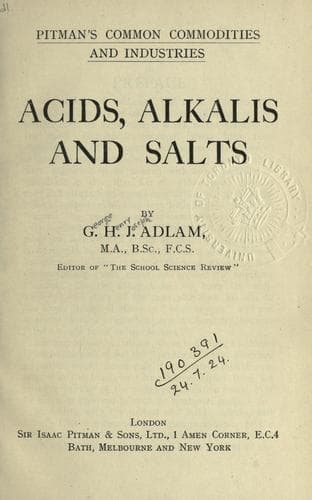
Acids, Alkalis and SaltsAdlam, George Henry Joseph
Science
Acids, Alkalis and Salts
Adlam, George Henry Joseph
Acids; Alkalies; Salts
The size of the chambers has varied a great deal. In the early years of
the nineteenth century, the capacity of a single chamber was probably
not more than 1,000 cu. ft.; at the present time, 38,000 cu. ft. is an
average size, and there may be three or five of these chambers. The
necessity for this large amount of cubic space is easily accounted for.
The reaction materials are all gases, and a gas occupies more than one
thousand times as much space as an equal weight of a solid or liquid.
Moreover, oxygen constitutes only about one-fifth of the total volume of
air used in burning the pyrites; the other four-fifths is mainly
nitrogen, which, though it does not enter into the reaction at all, has
to pass through the chambers.
Modern Improvements. Among the modern innovations in the lead chamber
process, the following are worthy of note. “Atomized water,” that is,
water under high pressure delivered from a fine jet against a metal
plate, has certain advantages over steam. In order to bring about a more
rapid mixing of the gases in the chamber, it is proposed to make these
circular instead of rectangular, and to deliver the gases tangentially
to the sides. Another suggestion is to replace the lead chambers by
towers containing perforated stoneware plates set horizontally. By this
arrangement, since the holes are not placed opposite one another, the
gases passing up the tower must take a zig-zag course. This makes for
more efficient mixing.
THE CONTACT PROCESS
Sulphur Trioxide. When elements are combined in different proportions by
weight, they produce different compounds. Thus, in the case of sulphur
and oxygen, there are two well-known compounds, namely, sulphur dioxide
and sulphur trioxide. In the former, a given weight of oxygen is
combined with an _equal_ weight of sulphur; in the latter, this same
weight of sulphur is combined with 50 per cent. more oxygen. On this
account, sulphur trioxide is spoken of as the higher oxide.
We can now state in general terms another method by which sulphuric acid
can be built up from its elements. Sulphur, as we have seen, burns in
oxygen, forming sulphur dioxide. This substance can then be made to
unite with more oxygen to give sulphur trioxide, which, with water,
yields sulphuric acid. There are three steps in this synthesis. The
first, namely, sulphur to sulphur dioxide, has already been considered;
the last, sulphur trioxide to sulphuric acid, only requires that sulphur
trioxide and water shall be brought together: we can, therefore, confine
our attention to the intermediate step, namely, the conversion of
sulphur dioxide into trioxide.
Public-domain text, read in full here on John Shaqi.
Reviews
Reviews
No reviews yet
Be the first to share your thoughts on this work.
Join the Discussion
Join the discussion
Sign in to leave a comment or review.
Sign InorCreate an account