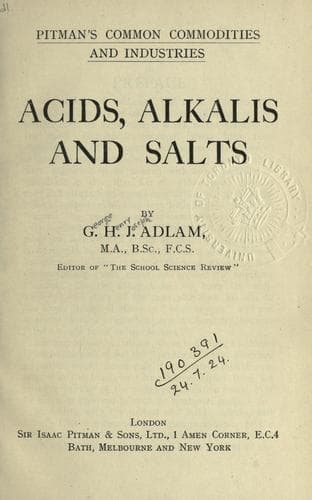
Acids, Alkalis and SaltsAdlam, George Henry Joseph
Science
Acids, Alkalis and Salts
Adlam, George Henry Joseph
Acids; Alkalies; Salts
For printing on calico, the mordant is thickened with gum arabic or
other glutinous substance. The design is then stamped on the material
with the thickened mordant liquor. The subsequent treatment consists of
dipping the material in the dye and afterwards in water, when the colour
comes away from those parts which have not received the impress of the
mordant.
Sodium Sulphate, or Glauber’s salt, is made from common salt by the
action of concentrated sulphuric acid. It is one of the raw materials
used in making glass.
Ammonium Sulphate. (_See_ p. 99.)
Calcium Sulphate, or gypsum, occurs in large quantities in Nature. The
salt contains 20·9 per cent. of combined water, and when carefully
heated to 120° C, it loses about two-thirds of this water, yielding a
white powder known as plaster of Paris. This substance, when made into a
paste with water, gradually sets to a hard mass, because the partially
dehydrated gypsum re-combines with the water.
Lead Sulphate, the chief impurity of commercial oil of vitriol, is a
white powder which is very often used for making white paint in place of
lead carbonate (white lead). The sulphate has the advantage over the
carbonate in not being so readily discoloured; its disadvantage is that
it lacks “body.”
Copper Sulphate, or blue vitriol, is frequently found in the drainage of
copper mines, where it is formed by the oxidation of copper pyrites. It
is made on a large scale by roasting sulphide ores of copper in a
current of air. Oxygen combines with copper sulphide, forming copper
sulphate, which is extracted with water and crystallized. It forms large
blue crystals containing 36 per cent. of water. This salt is put to many
different uses. Very large quantities are used for dyeing and calico
printing; some of the green pigments, such as Schweinfurt green, are
made from it.
CHAPTER III
NITRIC ACID AND NITRATES
Nitric acid, the _aqua fortis_ of the alchemists, must be placed next to
sulphuric acid in the scale of relative importance, because of the
variety of its uses. It is indispensable for making explosives, and is
used for the preparation of drugs and fine chemicals, including the
coal-tar dyes. The acid also dissolves many metals, forming nitrates,
which are put to several uses. Silver nitrate is the basis of marking
ink, and it is also the substance from which the light-sensitive silver
compounds required for the photographic industry are made. The important
pigments, chrome yellow and chrome red, are prepared from lead nitrate.
The solvent action of nitric acid on copper is made use of in etching
designs on copper plates. Over and above all this, it must be mentioned
that an adequate supply of “nitrate” is required for artificial manure.
Thus it can be said that with the uses of this acid and its salts are
associated our supply of daily bread, our freedom from foreign
oppression, and many of the refinements and conveniences of life.
Public-domain text, read in full here on John Shaqi.
Reviews
Reviews
No reviews yet
Be the first to share your thoughts on this work.
Join the Discussion
Join the discussion
Sign in to leave a comment or review.
Sign InorCreate an account