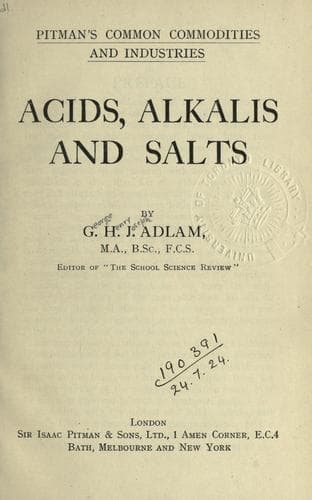
Acids, Alkalis and SaltsAdlam, George Henry Joseph
Science
Acids, Alkalis and Salts
Adlam, George Henry Joseph
Acids; Alkalies; Salts
The position which sulphuric acid occupies in Chemistry is due mainly to
three outstanding features. In the first place, it is a strong mineral
acid and displaces all other acids from their salts. Secondly, it has a
high boiling point (338° C.), and consequently, the displaced acid with
the lower boiling point can be distilled from the mixture. Lastly,
sulphuric acid can be made very cheaply from materials which are very
abundant in Nature, and, therefore, it meets all the requirements of an
acid which is to be used for general purposes.
SULPHATES
All the common metals, except gold and platinum, dissolve either in
concentrated or in dilute sulphuric acid, forming sulphates. These salts
are highly important and interesting substances. They are all soluble in
water, with the exception of the sulphates of calcium, strontium,
barium, and lead.
Ferrous Sulphate, also called green vitriol and copperas, is obtained by
dissolving iron in dilute sulphuric acid. The solution is green, and
when it is evaporated, the crystals which separate out look like bits of
green glass. It was because of this that the substance was first called
green vitriol (_vitrum_ = glass). It is used very largely in dyeing as a
mordant. Writing ink and Prussian blue are also made from it.
The Alums are double sulphates. They are made by crystallizing solutions
of potassium, sodium, or ammonium sulphate together with solutions of
iron (ferric), chromium, or aluminium sulphates. In this way, we may
have potassium aluminium alum, or iron ammonium alum, and so on, but
whichever combination of elements is present, the salt which is formed
always crystallizes in octahedra. The chief use of the alums, as also of
aluminium sulphate, is as mordants in dyeing.
Since a great many metallic salts, particularly acetates and sulphates,
are used in the dye industry as mordants, it may be well to explain here
very briefly what a mordant is.
It must be remembered that almost all the dyes are solids which dissolve
in water, yielding intensely coloured solutions. Hence, in most cases,
if a fabric is merely dipped in the dye and then dried, the colouring is
not permanent, but can be washed out with water. In order to fix the
colouring matter, the material is first dipped in the mordant, usually a
bath of some metallic salt, and then, generally after exposure to air or
after steaming, into the dye bath, with the result that the colour
becomes fixed. The first part of the process is called “mordanting” the
material. The mordant either adheres to or combines with the fibres, and
the dye forms with the mordant a coloured compound called a “lake,”
which resists the action of water. The colour is then said to be “fast,”
that is, firmly fixed.
Public-domain text, read in full here on John Shaqi.
Reviews
Reviews
No reviews yet
Be the first to share your thoughts on this work.
Join the Discussion
Join the discussion
Sign in to leave a comment or review.
Sign InorCreate an account