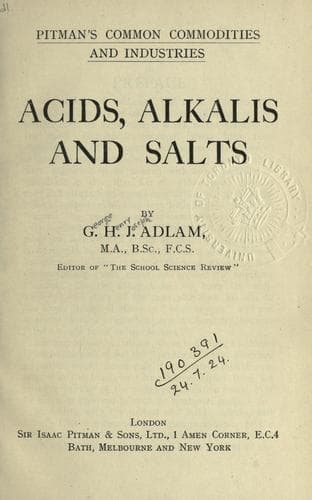
Acids, Alkalis and SaltsAdlam, George Henry Joseph
Science
Acids, Alkalis and Salts
Adlam, George Henry Joseph
Acids; Alkalies; Salts
Pure nitric acid will set fire to warm, dry sawdust, and a piece of
charcoal or sulphur thrown on the surface of molten nitre takes fire
spontaneously and is quickly consumed, giving out a very vivid light.
The explanation of this is that the supply of oxygen is abundant; it is
also readily available and concentrated in a small space. We can vary
the experiment. When a mixture of 75 parts by weight of finely-powdered
saltpetre, with 15 of charcoal dust and 10 of ground sulphur, is
ignited, it burns very vigorously, and is soon consumed. This mixture
is, indeed, home-made gunpowder.
Explosives. Gunpowder was discovered in very early times by the Chinese,
but for many years the secret of its composition did not get outside the
Great Wall. In the fifth century A.D., it was apparently re-discovered
at Constantinople, and that city was for a long time defended by the use
of what is known in history as Greek Fire, an incendiary mixture very
similar to, if not actually the same as, gunpowder. But again the secret
of its composition was jealously guarded, and it was not until the
thirteenth century that it was discovered, apparently for the third
time, and introduced to Western Europe by Roger Bacon. It was used in
siege cannon early in the fourteenth century and in field guns at Crécy;
but it was apparently not employed for blasting until about 1627,
although in 1605, Guy Fawkes and his fellow-conspirators were able to
obtain it in large quantity.
From the battle of Crécy in 1346 to the beginning of the South African
campaign in 1889, gunpowder was the only explosive used in warfare.
“Villainous saltpetre” has therefore played a very important part in
shaping the course of events in the world’s history. At the present day,
gunpowder has become “old-fashioned.” In warfare, it has been superseded
by “smokeless” powders of much greater power; while for mining
operations, explosives with a much greater shattering effect have long
since taken its place.
The composition of gunpowder may vary, but on the average it contains 75
parts by weight of saltpetre to 15 of charcoal and 10 of sulphur. It is,
therefore, a mixture of two combustible substances, with a large
quantity of a third very rich in oxygen. The separate constituents are
very finely ground and afterwards thoroughly incorporated. When the
mixture is ignited, charcoal and sulphur burn very fiercely in the
oxygen supplied by the saltpetre.
The secret of the action of gunpowder lies in the extraordinary rapidity
with which combustion, started at one point, is propagated through the
whole mass. Moreover, the products of combustion are mainly gases, and
these occupy several thousand times the volume of the solid from which
they are produced. In a confined space, a gas may exert enormous
pressure when its normal tendency to expand is resisted.
Public-domain text, read in full here on John Shaqi.
Reviews
Reviews
No reviews yet
Be the first to share your thoughts on this work.
Join the Discussion
Join the discussion
Sign in to leave a comment or review.
Sign InorCreate an account