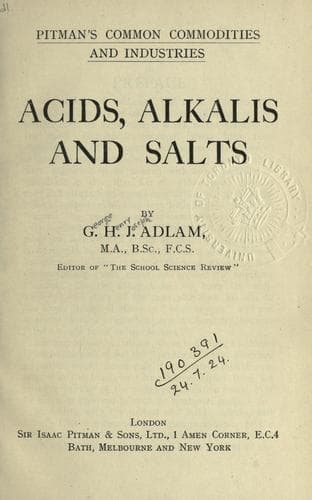
Acids, Alkalis and SaltsAdlam, George Henry Joseph
Science
Acids, Alkalis and Salts
Adlam, George Henry Joseph
Acids; Alkalies; Salts
_Trinitrotoluene_ (T.N.T.) is made from toluene and nitric acid, and is
a type of the modern high explosive. It is a yellow crystalline
substance which melts at 79°-81·5° C., and is poured into the shell in a
molten condition. It is a remarkably stable substance, which burns
quickly when heated to 180° C.; it cannot be exploded even by hammering.
Explosion is only brought about by that of a subsidiary substance called
the detonator. The percentage composition of T.N.T. is as follows—
Carbon 33·5
Hydrogen 2·3
Nitrogen 19·5
Oxygen 44·7
100·0
The oxygen present is only just sufficient to burn the whole of the
carbon to carbon monoxide; but since carbon dioxide is also formed,
which requires twice as much oxygen for the same weight of carbon, and
since the hydrogen and nitrogen may also be oxidized, the combustion of
the carbon is not complete; and therefore the explosion of T.N.T. is
accompanied by a dense black smoke, consisting of finely divided
particles of carbon.
The explosive known as ammonal is a mixture of T.N.T., aluminium powder,
and ammonium nitrate; the function of the latter substance is to supply
more oxygen to render the combustion of the carbon of T.N.T. complete.
Nitrates and the Food Supply. Chemical analysis shows that compounds of
nitrogen enter largely into the composition of the living tissues of all
plants and animals; hence, either nitrogen itself or some of its
compounds must be assimilated by all living organisms to provide for
growth and development, and to repair wastage. Air, since it contains
approximately four-fifths of its volume of free nitrogen, is the most
obvious source of supply. At every breath, a mixture of oxygen and
nitrogen is inhaled by animals, but only part of the oxygen is used.
Practically the whole of the nitrogen is returned to the atmosphere
unchanged; it serves only to dilute the oxygen. From this it is clear
that animals do not build up their nitrogenous constituents from
elementary nitrogen.
With plants it is very much the same, for, although they obtain their
principal food, namely, carbon, from the carbon dioxide which is present
in air, it is only in a few exceptional cases that free nitrogen is
assimilated. The exceptions will be considered first, because it was
through these that we first began to learn something definite about the
great importance of nitrogen in agriculture.
Virgil, who was born in 70 B.C., wrote a poem in praise of agriculture.
Almost in the opening lines he deals with the treatment of corn land. He
advises that, in alternate years, this should either be left fallow or
sown with pulse, vetch, or lupin; but not with flax or oats, because
they exhaust the land. From this we learn that rotation of crops was one
of the established principles of good husbandry even at the beginning of
the Christian era.
Public-domain text, read in full here on John Shaqi.
Reviews
Reviews
No reviews yet
Be the first to share your thoughts on this work.
Join the Discussion
Join the discussion
Sign in to leave a comment or review.
Sign InorCreate an account