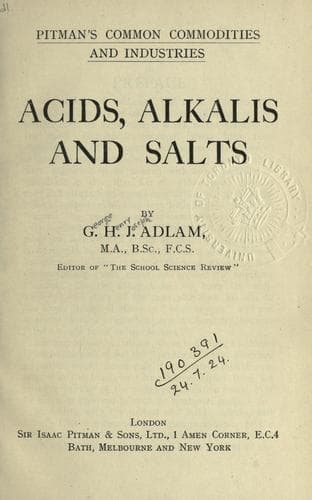
Acids, Alkalis and SaltsAdlam, George Henry Joseph
Science
Acids, Alkalis and Salts
Adlam, George Henry Joseph
Acids; Alkalies; Salts
A group of acids, namely, hydrochloric, hydrofluoric, hydrobromic,
hydriodic, must now be considered together with their corresponding
salts. In appearance and in other physical properties they resemble one
another very closely; they are, therefore, called by the general name
“halogen acids.” This name is derived from the Greek word meaning
“sea-salt,” which is a mixture of the salts of these acids, and from
which the acids themselves can be obtained by treatment with oil of
vitriol.
Hydrochloric Acid. When concentrated sulphuric acid is added to common
salt, a gas is liberated which has a very pungent acid smell and taste.
This is a compound of the elements hydrogen and chlorine, and therefore
called hydrogen chloride. It is extremely soluble in water; a given
volume of water dissolves as much as 500 times its own volume of the
gas. The solution produced in this way is now called hydrochloric acid,
but formerly it was known as spirits of salt, or muriatic acid.
Hydrochloric acid has all the general properties of acids. It dissolves
many metals, such as zinc, iron, aluminium, and magnesium; hydrogen gas
is given off, and the chloride of the metal is formed. It also dissolves
limestone, marble, and all forms of calcium carbonate; carbon dioxide
gas is liberated, and a solution of calcium chloride remains.
The hydrochloric acid of commerce is obtained as a by-product in the
manufacture of washing soda from common salt by the method proposed by
Nicholas Leblanc towards the end of the eighteenth century. In the first
stage of this process, salt is mixed with sulphuric acid; this causes
the liberation of hydrogen chloride gas, which, when dissolved in water,
produces hydrochloric acid.
The past history of this branch of chemical industry is interesting.
Until about 1870, there was no very great demand for hydrochloric acid,
and in the early days of the working of the Leblanc process the soda
manufacturer took no pains to recover more than he could actually sell.
Consequently, a large quantity of hydrogen chloride gas was allowed to
escape into the air, with results which can well be imagined. For miles
around, great damage was frequently sustained by the growing crops; when
it rained in the neighbourhood of the works, the gas was washed out of
the air and, speaking quite literally, it rained dilute hydrochloric
acid, which rapidly corroded all stone and metal work. It is not,
therefore, surprising to learn that alkali makers were frequently
involved in litigation, and chemical works were regarded as a great
nuisance.
By the Alkali Act of 1863, chemical manufacturers were compelled to
prevent the escape of more than 5 per cent. of hydrochloric acid gas;
and by a subsequent Act, this limit was lowered to 0·2 grain per cubic
foot. The provisions of the Acts were not difficult to carry out,
because hydrogen chloride is extremely soluble in water.
Public-domain text, read in full here on John Shaqi.
Reviews
Reviews
No reviews yet
Be the first to share your thoughts on this work.
Join the Discussion
Join the discussion
Sign in to leave a comment or review.
Sign InorCreate an account