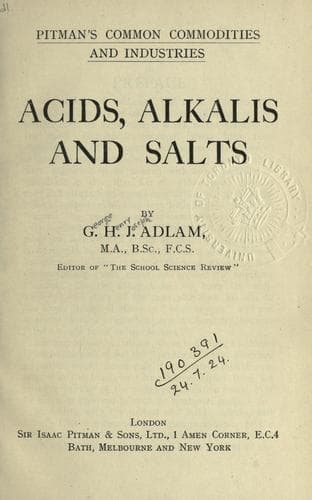
Acids, Alkalis and SaltsAdlam, George Henry Joseph
Science
Acids, Alkalis and Salts
Adlam, George Henry Joseph
Acids; Alkalies; Salts
Hydrobromic and Hydriodic Acids are not much used, but their salts, the
bromides and iodides respectively, are of great technical importance.
Silver chloride, bromide, and iodide, are sensitive to light, and mixed
with gelatine they form the emulsion which is spread over photographic
plates and papers. Potassium bromide and iodide are also well known to
photographers.
When the halogen salts of silver are exposed to light, an extremely
subtle chemical change takes place, which is only made apparent when the
plate or paper is developed. Then the silver salts on which the light
has fallen are reduced to metallic silver, and this reduction is
greatest where the light was most intense, and in other places is
proportional to the light intensity. A very faint image may appear on
the plate while it is in the developer, but generally the image is only
brought out clearly when the plate, film, or paper is placed in “hypo”
solution, which dissolves out the silver salts which have not been
changed, leaving the metallic silver unaffected.
CHAPTER V
CARBONIC ACID AND CARBONATES
Carbon. When any product of animal or vegetable life is strongly heated
in a vessel from which all air currents are excluded, a mixture of gases
and liquids is driven off, and a charred mass remains. This residue,
from whatever source obtained, is composed mainly of the element carbon.
It sometimes happens that a loaf of bread or a cake is left in the oven
and forgotten. In popular language it is then said to be “burnt to a
cinder”; in reality, the surface layers have been converted into carbon.
Carbonic Acid. If carbon is heated in an open vessel provided with a
good draught, it glows and in time disappears, because it combines with
oxygen to form an invisible gas, carbon dioxide or carbonic acid gas,
which, when dissolved in water, forms carbonic acid.
Compared with the acids which have been described in the foregoing
chapters, this is a very feeble acid; it changes the colour of litmus to
a wine red, not a bright pink; its taste is just pleasantly acid, and
its solvent action on metals and limestone is very small indeed. The
solution of the acid, obtained by passing carbon dioxide into water, is,
of course, very dilute, and it cannot be concentrated by evaporation,
since this only results in expelling the carbon dioxide from solution,
leaving pure water.
Soda Water. In the case of most gases, the weight which dissolves in a
given quantity of water is proportional to the pressure. This is true
for carbonic acid gas. Under a pressure of 4 atmospheres, the weight of
gas which dissolves is four times as great as under a pressure of one
atmosphere.
Public-domain text, read in full here on John Shaqi.
Reviews
Reviews
No reviews yet
Be the first to share your thoughts on this work.
Join the Discussion
Join the discussion
Sign in to leave a comment or review.
Sign InorCreate an account