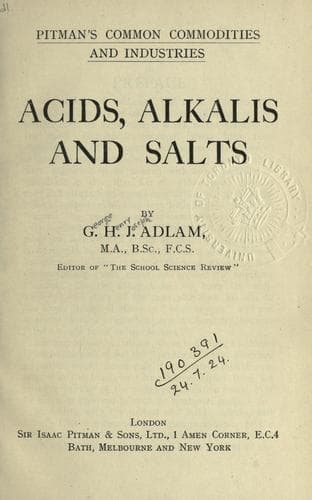
Acids, Alkalis and SaltsAdlam, George Henry Joseph
Science
Acids, Alkalis and Salts
Adlam, George Henry Joseph
Acids; Alkalies; Salts
The demand for bleaching powder is great and steadily increasing. The
price of 35 per cent. bleaching powder has never been less than about £5
a ton,[3] so that it is perhaps unnecessary to add that the absorption
of hydrogen chloride gas is now made so complete that it is well within
the requirements of the second Alkali Act.
Chlorides. The salts of hydrochloric acid are called chlorides, and the
most important of these is sodium chloride or common salt—a body that is
so well known that it need not be described here.
Although the quantity of this substance required for domestic purposes
is very large, it is, nevertheless, small by comparison with that which
is used for industrial purposes. It has already been mentioned that salt
is the starting-point for the manufacture of washing soda by the Leblanc
process, and, in addition to this, it is employed in the glass industry
to produce whiteness and transparency in certain kinds of glass; in
pottery, for glazing earthenware; in soap-making, for salting out the
crude soap; and in the dye trade as a mordant, and also for improving
the quality of certain colours. A full account of the salt industry is
given in another volume of this series.
Hydrofluoric Acid. When calcium fluoride (fluorspar, Derbyshire spar, or
blue-john) is warmed with concentrated sulphuric acid in a leaden dish,
hydrogen fluoride gas is evolved, and this, when dissolved in water,
gives hydrofluoric acid.
The peculiar property of this substance is that it has a very marked
corrosive action on glass. It cannot, therefore, be kept in glass
vessels, but must be stored in bottles made of hardened caoutchouc. On
the other hand, it is this same property which gives it its place in
commerce. As far back as 1670 it was used for etching on glass. The
process is a very simple one. The article is first coated with wax,
which is then removed in places by a sharp pointed tool. When exposed to
the action of the gas or its solution, corrosion takes place only where
the glass has been laid bare, the other parts being protected by the
wax. After a short interval, the wax can be melted off, and the design
made more distinct by rubbing in some opaque cement. For general trade
purposes, such as the stamping of lamp chimneys or electric light bulbs,
a quicker method is required. In this case, a preparation of
hydrofluoric acid which can be applied with a rubber stamp is used.
Fluorspar or calcium fluoride is the most important salt of hydrofluoric
acid. It is a commonly occurring mineral, and besides its use for the
preparation of the acid, it is employed in many metallurgical operations
to form a fusible slag.
Public-domain text, read in full here on John Shaqi.
Reviews
Reviews
No reviews yet
Be the first to share your thoughts on this work.
Join the Discussion
Join the discussion
Sign in to leave a comment or review.
Sign InorCreate an account