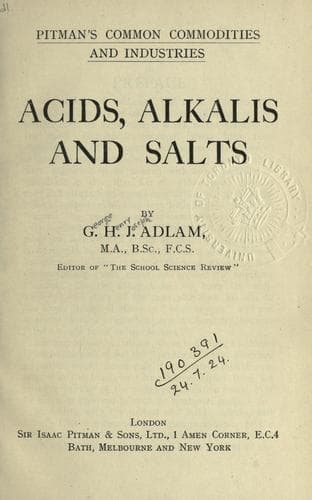
Acids, Alkalis and SaltsAdlam, George Henry Joseph
Science
Acids, Alkalis and Salts
Adlam, George Henry Joseph
Acids; Alkalies; Salts
Quicklime. The making of lime from limestone or chalk is called lime
burning. The operation is carried out in a structure called a lime kiln,
which is usually a barrel-shaped vertical shaft surrounded by
substantial brickwork. There are two main methods of procedure, the one
continuous and the other intermittent. In the continuous process, the
kiln is filled up with limestone and fuel (generally coke) in alternate
layers. Combustion is started at the bottom and maintained by a
regulated draught. As the charge works down, the addition of limestone
and fuel is continued from the top, while the lime is removed from the
bottom of the kiln. The lime produced by this method has the ashes of
the fuel mixed with it. To avoid this, the more modern type of kiln has
four lateral fire grates outside the actual kiln.
For the intermittent method, a kiln is required which has a fireplace at
the bottom. Over this a rough arch is built of large pieces of
limestone, laid dry, and then the kiln is filled up with pieces of
limestone which decrease in size from below upwards. The fire is kindled
beneath the arch and urged by a regulated draught. The heating is
maintained for three days and nights, after which time the charge is
allowed to cool down.
Carbonic Acid Gas in Nature. Although the solvent action of carbonic
acid is very small compared with that of strong acids, it is
nevertheless great in comparison with that of water. This is shown
especially in its action on limestone, an action from which several
important consequences arise. Rain, as it falls through the air,
dissolves a little carbon dioxide and, although this is only an
exceedingly dilute solution of a very weak acid, its cumulative effect,
especially in limestone districts, is very great; it hollows out
enormous caves and causes the formation of those fantastic creations in
stone known as stalactites and stalagmites.
When a drop of water charged with carbonic acid gas falls on limestone,
it dissolves a little of that substance, forming calcium bicarbonate,
which may be regarded as a compound of calcium carbonate, carbon
dioxide, and water. Little by little, the solid rock is hollowed out and
a cave, or perhaps an underground watercourse, is formed.
Again, the drop of water charged with calcium bicarbonate may find its
way to the roof of a cave. As it hangs from the roof while it gathers
strength to fall, a little of the carbon dioxide escapes, and a minute
quantity of calcium carbonate is deposited. In this way, a stalactite
looking like an icicle in stone gradually grows downwards.
When the drop reaches the floor of the cave, a little time elapses
before it sinks into the ground; again a little carbon dioxide escapes,
and a small quantity of calcium carbonate is formed. Little is added to
little, and in the course of ages the stalagmite grows upward from the
floor and ultimately meets the stalactite to form a continuous column of
glistening crystallized calcium carbonate.
Public-domain text, read in full here on John Shaqi.
Reviews
Reviews
No reviews yet
Be the first to share your thoughts on this work.
Join the Discussion
Join the discussion
Sign in to leave a comment or review.
Sign InorCreate an account