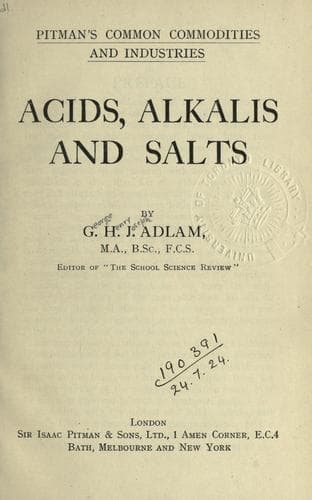
Acids, Alkalis and SaltsAdlam, George Henry Joseph
Science
Acids, Alkalis and Salts
Adlam, George Henry Joseph
Acids; Alkalies; Salts
Hard and Soft Water. Water that is used for domestic or manufacturing
purposes is described as either hard or soft. Soft water produces a soap
lather almost at once; hard water forms at first a scum or curd which
has no detergent properties, and only after a time gives the soap lather
which is required. The difference is due to the relative amount of
dissolved solid contained in the water.
Only distilled water or rain water collected in the open country is
perfectly soft, for this is the only kind of water which on being
evaporated to dryness leaves no solid residue. In districts where the
underlying strata are composed of hard insoluble rock, such as granite
or millstone grit, the water contains very little dissolved matter and
is relatively soft. In a limestone or chalk country, water is very hard
and in many cases has to be softened either before delivery or before
use.
The chief impurities which cause hardness are the chlorides, sulphates,
and bicarbonates of magnesium and calcium. The chlorides and sulphates
are not affected in any way by boiling, and the hardness which is due to
them is said to be “permanent.” The bicarbonates, on the other hand, are
decomposed when the water is boiled, and then they cease to cause the
water to be hard. This part of the hardness is spoken of as “temporary”
hardness.
Let us now consider what calcium bicarbonate is and how it is formed. It
is a compound of calcium carbonate and carbonic acid, and is formed by
the solvent action of carbonic acid on limestone or chalk. The compound
is soluble in water; but when the solution is boiled, the carbonic acid
is broken up, carbonic acid gas is expelled from the solution, and
calcium carbonate is formed.
Temporary hardness is the more troublesome. In the first place, the
bicarbonates, especially that of calcium, often form the greater part of
the dissolved impurity. Moreover, when the water is boiled, although the
hardness is removed, the insoluble calcium carbonate is a source of
trouble, for it gradually settles down into the hard mass known as “fur”
in kettles and “scale” in boilers.
It is perhaps necessary at this point to emphasize the fact that matter
_suspended_ in water does not make it hard, and it is only matter which
is _dissolved_ which makes any difference in this respect.
Since the softening of temporary hard water by boiling has the
undesirable feature of introducing solid matter into the boiler, it is
customary now to treat this water chemically. The following is the
process most generally used. Quicklime or slaked lime is stirred into
the water until the mixture gives a faint brown coloration when a drop
of silver nitrate is added to a small test portion. Unsoftened water is
then added until a sample just ceases to give this test. The temporary
hardness has then been removed, and it is only necessary to allow the
suspended matter to settle.
Public-domain text, read in full here on John Shaqi.
Reviews
Reviews
No reviews yet
Be the first to share your thoughts on this work.
Join the Discussion
Join the discussion
Sign in to leave a comment or review.
Sign InorCreate an account