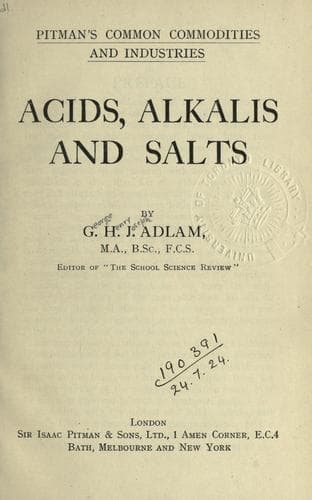
Acids, Alkalis and SaltsAdlam, George Henry Joseph
Science
Acids, Alkalis and Salts
Adlam, George Henry Joseph
Acids; Alkalies; Salts
Acids. A vague hint from Nature gave mankind the first indication of the
existence of acids. The juice pressed from ripe grapes is a sweetish
liquid. If it is kept for some time, the sweetness goes, and the liquid
acquires a burning taste. If kept still longer, the burning taste is
lost, and in its place a sharp acid flavour, not entirely displeasing to
the palate, is developed. The liquid obtained in this way is now called
wine vinegar; the particular substance which gives it its characteristic
taste is acetic acid.
The strongest vinegar does not contain more than 10 per cent. of acetic
acid, which is itself a comparatively weak acid. It is, therefore, not a
very active solvent. Nevertheless, for metals and for limestone rock,
and other substances of a calcareous nature, its solvent power is
greater than that of any other liquid known at the time of its
discovery. It was this property which seems to have appealed most
strongly to the imagination of the early chemists; and, as is very often
the case, the description of its powers was very much exaggerated. Livy
and Plutarch, who have given us an account of Hannibal’s invasion of
Italy by way of the Alps, both gravely declare that the Carthaginian
leader cleared a passage for his elephants through solid rocks by
pouring vinegar over them!
In the Middle Ages, the study of Chemistry was fostered mainly as a
possible means whereby long life and untold riches might be obtained.
The “Philosopher’s Stone,” by the agency of which the base metals were
to be changed to gold, and the “Elixir of Life,” which was to banish
disease and death, were eagerly sought for. Though these were vain
imaginings according to modern ideas, nevertheless they were powerful
incentives towards experimental work. Many new substances were
discovered in this period, and among these were nitric acid (aqua
fortis), hydrochloric acid (spirit of salt), and sulphuric acid (oil of
vitriol).
Acids were then valued above all other substances. The mediaeval chemist
(or alchemist, as he was called) clearly saw that unless a body could be
dissolved up there was no hope of changing it. Nitric acid, therefore,
which, in conjunction with hydrochloric acid, dissolved even gold
itself, was very highly esteemed. Oil of vitriol also was scarcely less
important, for it was required for the production of other acids.
So far, taste and solvent power were considered to be the characteristic
feature of acids. In the time of Robert Boyle (1627-1691), they were
further distinguished from other substances by the change which they
produced in the colour of certain vegetable extracts. Tincture of red
cabbage was first used, but, as this liquid rapidly deteriorates on
keeping, it was soon replaced by a solution of litmus, a colouring
matter obtained from _Roccella tinctoria_ and other lichens. It imparts
to water a purple colour, which is changed to red by the addition of
acids.
Public-domain text, read in full here on John Shaqi.
Reviews
Reviews
No reviews yet
Be the first to share your thoughts on this work.
Join the Discussion
Join the discussion
Sign in to leave a comment or review.
Sign InorCreate an account