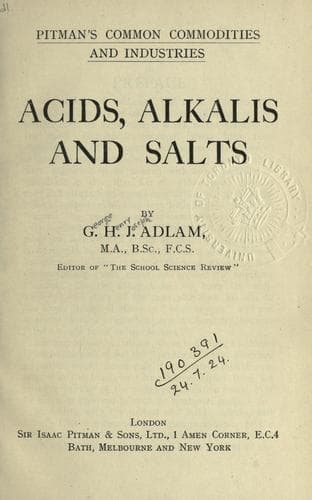
Acids, Alkalis and SaltsAdlam, George Henry Joseph
Science
Acids, Alkalis and Salts
Adlam, George Henry Joseph
Acids; Alkalies; Salts
Like all other plants, _Mycoderma aceti_ will flourish only under
certain favourable conditions. In the first place, it requires
nourishment, and therefore certain nitrogen compounds and salts must be
present in the alcoholic solution. These are contained in wines, beer,
cider, and malt liquors, but not in spirits of wine, which is pure
alcohol distilled from liquids which have undergone vinous fermentation.
If the plant is placed in dilute spirits of wine, only a very little
acetic acid is formed, and then the action ceases because the solution
does not contain the necessary food substances. Temperature also has a
very marked effect on growth, the most favourable range being between
68° and 95° F.
Alcohol is changed to acetic acid by the process of oxidation, and
therefore, in making vinegar, arrangements have to be made to bring
together weak alcohol and air in the presence of the plant. The ferment
which is secreted by the plant then causes an acceleration of the
reaction. There is a considerable amount of similarity between
fermentation and contact action. In this connection, it is interesting
to note that the conversion of alcohol into acetic acid can also be
brought about by exposing a mixture of alcohol vapour and air to the
action of platinum black; in fact, there is one process for making
vinegar in this way.
French Vinegar. New wine, especially that which contains a low
percentage of alcohol, is liable to many kinds of “sickness.” It may
turn bitter, it may turn sour, or it may undergo what is called lactic
fermentation. In either case, it becomes unsaleable as a beverage. Wine
which has turned sour is the best material for making vinegar, and when
this is done by the French or slow process, a product with a very fine
_bouquet_ is obtained.
The methods adopted are very simple. Formerly, the wine was poured into
barrels leaving the top portion empty, and providing for a current of
air over the surface. The barrels were often set up in rows in the open
air in an enclosure which was then known as a “vinegar field.” The
process of souring which had already begun went on naturally, and in the
course of a few months, nearly the whole of the alcohol was converted
into acetic acid.
The process now in use in some of the French factories is somewhat
similar. Large casks holding about 100 gallons are set up in a room, and
provision is made for keeping the temperature uniform. Each cask is
first acidulated by allowing strong vinegar to stand in it until the
vinegar plant has developed on the surface. The casks are then filled up
very gradually by adding a few gallons of wine every eight or ten days.
When the cask is full, a fraction of the contents is drawn off and
replaced by wine. The process then becomes continuous, until it is
necessary to clean out the generator and start again.
Public-domain text, read in full here on John Shaqi.
Reviews
Reviews
No reviews yet
Be the first to share your thoughts on this work.
Join the Discussion
Join the discussion
Sign in to leave a comment or review.
Sign InorCreate an account