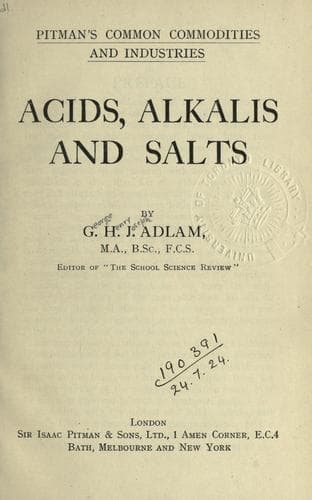
Acids, Alkalis and SaltsAdlam, George Henry Joseph
Science
Acids, Alkalis and Salts
Adlam, George Henry Joseph
Acids; Alkalies; Salts
In later times it was proved that substances like sugar, starch, urea,
indigo, and a great many more, all contain the element carbon. At the
present time, more than 100,000 compounds of this element are known; and
since they resemble one another, and at the same time differ in several
important respects from the compounds of other elements, it is both
natural and convenient that they should be classed together and studied
separately. This branch of Chemistry is called organic. It must not,
however, be supposed that all organic compounds are necessarily produced
by some living organism. A great many are, but there are many more which
are purely synthetic products.
Inorganic Chemistry includes all the other elements and their
derivatives. The _element_ carbon, and also some of its simpler
compounds, such as carbon monoxide, carbon dioxide, carbonic acid, and
carbonates, are more appropriately placed in the inorganic section.
The acids which have been considered up to this point are all inorganic
acids, and those which follow are organic. Sulphuric, nitric, and
hydrochloric acids are often distinguished as the mineral acids in
contradistinction to oxalic, citric, tartaric, and some others which
were first obtained from unripe fruits and therefore called vegetable
acids.
Organic acids have all the general properties of the class, but they are
much weaker than the mineral acids mentioned above. This is shown by
their solvent action on metals, oxides, and carbonates, which is in all
cases slight.
Vinegar is the trade name for what is essentially a dilute solution of
acetic acid which has been made by the acetous fermentation of
saccharine fluids containing weak alcohol. In addition to acetic acid,
vinegar contains minute quantities of a large number of compounds. Some
of these help to produce that agreeable flavour and aroma which
distinguishes vinegar from diluted acetic acid. The nature and quantity
of the flavouring constituents depend mainly upon the nature of the
alcoholic solution used.
Since the acetic acid in vinegar is always produced by fermentation, all
processes for the manufacture of vinegar are essentially arrangements
for promoting the vigorous growth and development of _Mycoderma aceti_,
the organism which produces the vinegar ferment.
Public-domain text, read in full here on John Shaqi.
Reviews
Reviews
No reviews yet
Be the first to share your thoughts on this work.
Join the Discussion
Join the discussion
Sign in to leave a comment or review.
Sign InorCreate an account