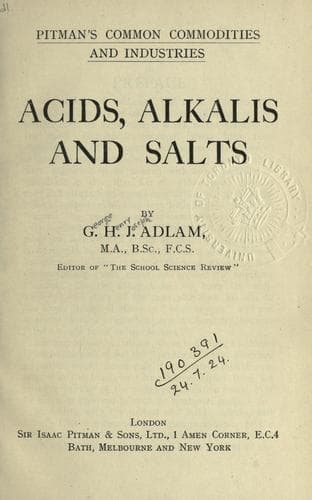
Acids, Alkalis and SaltsAdlam, George Henry Joseph
Science
Acids, Alkalis and Salts
Adlam, George Henry Joseph
Acids; Alkalies; Salts
The colour of wine vinegar is natural, but vinegar which is produced by
the quick process is colourless or only faintly coloured. Since the
public has a preference for vinegar which is brown in colour, the
product of the quick process is coloured artificially, either by adding
caramel or by preparing the weak spirit from malt which has been
slightly charred in drying.
Industrial Acetic Acid. The solutions of acetic acid dealt with above
would be too dilute for any industrial purpose; moreover, the acid can
be obtained much more cheaply by the distillation of wood. When wood is
subjected to a high temperature, it is converted into charcoal and, at
the same time, an inflammable gas, an acid liquid, and tar are given
off, and can be collected in suitable vessels. The following table, on
page 73, gives the relative amounts of the various substances obtained
from wood by dry distillation. The quantities are those derived from one
cord, that is, 125 cu. ft.
_Charcoal _Alcohol _Calcium _Tar in _Wood oil _Turpentine
in in acetate gallons._ in gallons._
bushels._ gallons._ in lbs._ gallons._
Hard 40-50 8-12 150-200 8-20
woods
Resinous 25-40 2-4 50-100 30-60 30-60 Heavy woods
woods 12-25
Light woods
2-10
Sawdust 25-35 2-4 45-75
The aqueous liquid that distils over contains methyl alcohol (wood
spirit), acetone, and acetic acid. The crude mixture is known as
pyroligneous acid. This is neutralized with milk of lime or soda ash,
which converts acetic acid into calcium or sodium acetate, but has no
action on the methyl alcohol and acetone which are also present. The
mixture is then distilled, when methyl alcohol, acetone, and water pass
over into the distillate, leaving the acetate in the retort.
To obtain the free acid from the acetate, the latter is well dried and
then distilled with concentrated sulphuric acid. Acetic acid, being the
more volatile of the two acids, distils over, and is nearly pure.
The method of removing the last traces of water depends upon the fact
that acetic acid solidifies at 17° C. The acid, which is nearly, but not
quite, free from water, is cooled until a portion solidifies. The part
which still remains liquid is poured away, and the process is repeated
until a residue is obtained which solidifies as a whole. This is glacial
acetic acid, so called because it is a mass of glistening plates which
look like newly-formed ice.
The Acetates
Public-domain text, read in full here on John Shaqi.
Reviews
Reviews
No reviews yet
Be the first to share your thoughts on this work.
Join the Discussion
Join the discussion
Sign in to leave a comment or review.
Sign InorCreate an account