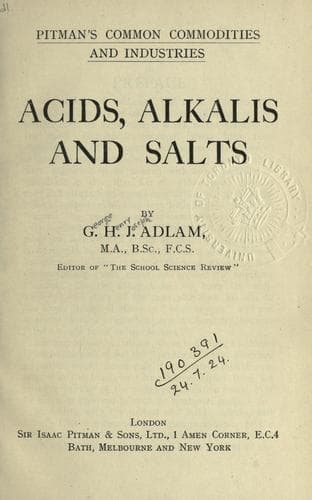
Acids, Alkalis and SaltsAdlam, George Henry Joseph
Science
Acids, Alkalis and Salts
Adlam, George Henry Joseph
Acids; Alkalies; Salts
Mild Soda and Potash. Until the middle of the eighteenth century, it was
thought that the soluble matter extracted from the ashes of all plants
was the same. In 1752 it was shown that the substance obtained in this
way from plants which grew in or near the sea differed from that from
land vegetation by producing a golden yellow colour when introduced into
the non-luminous flame of a spirit lamp, while that from land plants
gave to the flame a pale lilac tinge. The former substance is now known
as mild soda, and the latter as mild potash.
At this point it is well to make it clear to the reader that there are
two bodies commonly called soda, and two called potash. One of each pair
is caustic and one mild.
By a simple chemical test it is easy to distinguish a mild from a
caustic alkali. When a little dilute acid is added to the former, there
is a vigorous effervescence caused by the escape of carbon dioxide, but
no gas is given off when a caustic alkali is treated in the same way.
The liberation of carbon dioxide on the addition of acids shows that the
mild alkalis are carbonates.
Washing Soda is so well known, that very little description of its
external characteristics is necessary. It is a crystalline substance,
easily soluble in water. The crystals, when freshly prepared, are
semi-transparent; but after exposure to air for some time, they are
found to lose their transparency and to become coated with an opaque
white solid which crumbles easily. This change in appearance is
accompanied by a loss in weight.
Crystals of soda melt very easily on the application of heat and, on
continued heating, the liquid seems to boil. When this operation is
carried out in a vessel attached to a condenser, the vapour that is
given off from the melted soda condenses to a clear colourless liquid
which, on examination, proves to be water. When no more water collects
in the receiver, the vessel contains a dry, white solid, which by any
chemical test that may be applied is shown to be the same as washing
soda, but it contains no water of crystallization and has a different
crystalline form. This substance is anhydrous sodium carbonate, or soda
ash as it is called in commerce. When soda ash is mixed with water, it
combines with about twice its own weight of that liquid, forming soda
crystals again.
Washing soda, then, contains nearly two-thirds of its weight of water.
Some of this water is given off spontaneously when the soda is exposed
to air; the water may even be said to evaporate. This accounts for the
loss of weight observed and also for the formation of the white layer of
partially dehydrated soda over the surface of the crystal. The property
of losing water in this way is common to most crystals containing a high
percentage of water of crystallization. The phenomenon is known as
“efflorescence.” It may here be observed that crystals of washing soda
which have become coated over in this way contain relatively more soda
than those which are transparent.
Public-domain text, read in full here on John Shaqi.
Reviews
Reviews
No reviews yet
Be the first to share your thoughts on this work.
Join the Discussion
Join the discussion
Sign in to leave a comment or review.
Sign InorCreate an account