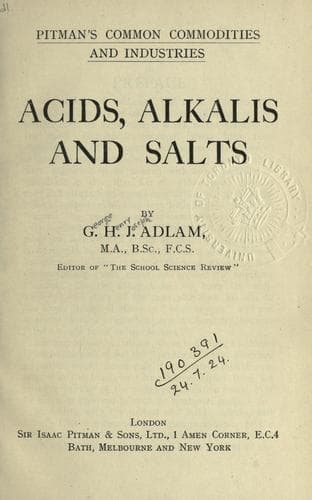
Acids, Alkalis and SaltsAdlam, George Henry Joseph
Science
Acids, Alkalis and Salts
Adlam, George Henry Joseph
Acids; Alkalies; Salts
All fats and vegetable oils can be resolved into their two constituents,
the acid and the glycerine. This can be brought about by heating the fat
with water to about 200° C. This operation must be carried out in a
vessel capable of withstanding pressure and closed with a safety valve;
otherwise, the requisite temperature could not be obtained. After this
treatment, there is left in the vessel an oily layer which solidifies on
cooling and an aqueous layer which contains the glycerine. The
solidified oily layer is the fatty acid. In the case of mutton or beef
tallow, it would be mainly a mixture of stearic and palmitic acids. This
mixture is used to make “stearin” candles. The acids themselves are
wax-like solids without any distinctive taste. Stearic acid melts at 69°
C. and palmitic at 62° C. They have no perceptible action on the colour
of litmus, neither have they any solvent action on metals or carbonates.
We should not recognize these substances as acids at all were it not for
the fact that they combine with alkalis, forming salts.
The salts of the fatty acids are called soaps. To make soap, the fat is
boiled with caustic alkali or caustic lye, as it is more often called.
This breaks the fat up primarily into the acid and glycerine; but in
this case, instead of obtaining the acid as the final product as we did
above by heating with water under pressure, we get the sodium or
potassium salt of the acid according to the alkali used. When caustic
soda is used, the product is a hard soap; when caustic potash is used,
it is a soft soap. The treatment of fats in this way with caustic
alkalis is called “saponification.”
CHAPTER VIII
MILD ALKALI
Caustic and Mild. There are two classes of alkalis distinguished by the
terms caustic and mild. If a piece of all-wool material is boiled with a
solution of caustic soda or potash, it dissolves completely, giving a
yellow solution. Mild alkali will not dissolve flannel, though it may
have some slight chemical action causing shrinkage. Partly for this
reason, and partly because commercial washing soda often contains a
little caustic soda, woollen garments must not be boiled or even washed
in hot soda water.
The disintegrating action of the caustic alkalis is also illustrated by
the use of caustic soda in the preparation of wood pulp for paper
making. Tree trunks are first torn up and shredded by machinery; but
notwithstanding the power of modern machinery, the fibre is not nearly
fine enough for the purpose until it has been “beaten” with a solution
of caustic soda, whereby the pulp is brought to a smooth and uniform
consistency like that of thin cream.
Public-domain text, read in full here on John Shaqi.
Reviews
Reviews
No reviews yet
Be the first to share your thoughts on this work.
Join the Discussion
Join the discussion
Sign in to leave a comment or review.
Sign InorCreate an account