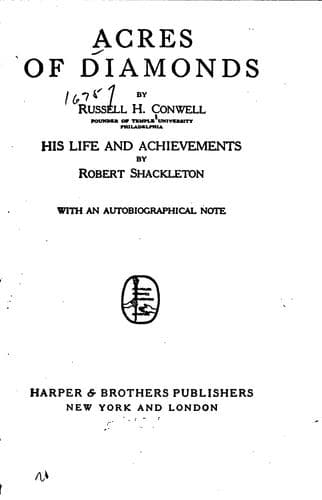
This stirring manifesto shows how to discover everything you need to succeed— where you least expect it.So begins one of the most famous speeches of the twentieth century, a talk that educator and minister Russell H. Conwell delivered before literally thousands of audiences before his death in 1925. In its printed version Acres of Diamonds reached millions of readers around the world. Conwell's great manifesto imparts one extraordinary lesson: All the wealth you could ever dream of, search for, or yearn after—in whatever form you wish for—exists right beneath your own feet. It is a message of determination, unconventional thinking, and positive living that came to influence a generation of motivational literature.The Success Classics edition of Acres of Diamonds also features two rare bonus works: Praying for Money and The Story of "Acres of Diamonds" by journalist Robert Shackleton.
The best thing I can do is to illustrate by actual facts well-known to
you all. A. T. Stewart, a poor boy in New York, had $1.50 to begin
life on. He lost 87 1/2 cents of that on the very first venture. How
fortunate that young man who loses the first time he gambles. That boy
said, “I will never gamble again in business,” and he never did. How
came he to lose 87 1/2 cents? You probably all know the story how he
lost it--because he bought some needles, threads, and buttons to sell
which people did not want, and had them left on his hands, a dead loss.
Said the boy, “I will not lose any more money in that way.” Then he went
around first to the doors and asked the people what they did want. Then
when he had found out what they wanted he invested his 62 1/2 cents to
supply a known demand. Study it wherever you choose--in business, in
your profession, in your housekeeping, whatever your life, that one
thing is the secret of success. You must first know the demand. You must
first know what people need, and then invest yourself where you are most
needed. A. T. Stewart went on that principle until he was worth what
amounted afterward to forty millions of dollars, owning the very store
in which Mr. Wanamaker carries on his great work in New York. His
fortune was made by his losing something, which taught him the great
lesson that he must only invest himself or his money in something
that people need. When will you salesmen learn it? When will you
manufacturers learn that you must know the changing needs of humanity if
you would succeed in life? Apply yourselves, all you Christian people,
as manufacturers or merchants or workmen to supply that human need. It
is a great principle as broad as humanity and as deep as the Scripture
itself.
The best illustration I ever heard was of John Jacob Astor. You know
that he made the money of the Astor family when he lived in New York. He
came across the sea in debt for his fare. But that poor boy with nothing
in his pocket made the fortune of the Astor family on one principle.
Some young man here to-night will say, “Well they could make those
fortunes over in New York but they could not do it in Philadelphia!” My
friends, did you ever read that wonderful book of Riis (his memory
is sweet to us because of his recent death), wherein is given his
statistical account of the records taken in 1889 of 107 millionaires
of New York. If you read the account you will see that out of the 107
millionaires only seven made their money in New York. Out of the 107
millionaires worth ten million dollars in real estate then, 67 of them
made their money in towns of less than 3,500 inhabitants. The richest
man in this country to-day, if you read the real-estate values, has
never moved away from a town of 3,500 inhabitants. It makes not so much
difference where you are as who you are. But if you cannot get rich in
Philadelphia you certainly cannot do it in New York.
Public-domain text, read in full here on John Shaqi.
Reviews
Reviews
No reviews yet
Be the first to share your thoughts on this work.
Join the Discussion
Join the discussion
Sign in to leave a comment or review.
Sign InorCreate an account